
ARTIST & KILN
Li Ximei 李细妹
Li Xinhong 李欣红 · Kaihe Kiln 开河窑 · Jianyang, Fujian

About Li Ximei
Li Ximei 李细妹, also known by the art name 李欣红 (Li Xinhong), is a contemporary Jian ware artist from Jianyang, Fujian. Born in 1955, she belongs to the generation of makers involved in the modern revival and development of Jian ware.
She began researching and experimenting with Jian ware firing during the late 1980s. Published accounts of her career associate her particularly with oil-drop, rabbit-hair, partridge-spot, and kiln-transmutation surfaces.
Li Ximei is closely associated with Kaihe Kiln 开河窑, where her work combines the traditional material language of Jian ware with continued experimentation in firing and glaze development.
Quick Facts
- Chinese name: 李细妹
- Art name: 李欣红
- Born: 1955
- Origin: Jianyang, Fujian
- Associated kiln: 开河窑 · Kaihe Kiln
- Known for: Oil-drop, rabbit-hair, partridge-spot, and kiln-transmutation Jian ware
- Recognition: Nanping municipal-level representative inheritor of Jian Kiln Jian Ware firing techniques
- Patent: CN108439953B, concerning a traditional black-glazed silver oil-drop Jian ware firing method
Jian Ware Revival
Li Ximei is part of the generation of Jianyang ceramic artists who helped develop modern Jian ware following the revival of the historic firing tradition in the late twentieth century.
Biographical accounts state that she began experimental work with Jian ware in 1987 and, after several years of research, achieved oil-drop results in the early 1990s.
Her later work expanded across several Jian ware glaze families and kiln-transmutation effects, with particular attention given to the interaction between iron-rich glaze, firing atmosphere, temperature, and cooling.
Intangible Cultural Heritage Recognition
Li Ximei is recognized as a representative inheritor connected with the traditional firing techniques of Jian Kiln Jian ware.
It is important to distinguish the level of the heritage project from the level of an individual inheritor. The Jian Kiln Jian Ware Firing Technique is recognized as a national-level intangible cultural heritage project, while records identify Li Ximei as a municipal-level representative inheritor in Nanping.
This distinction avoids the broader promotional description of her as an individual “national-level inheritor” when the available official designation is more specific.
Kaihe Kiln 开河窑
Li Ximei is closely associated with Kaihe Kiln and is described in Kaihe Kiln material as its founder and design director.
The kiln operates in Jianyang and focuses on the development, production, and promotion of Jian ware. Li Ximei’s technical work and documented intellectual property also connect her directly with the Kaihe Kiln organization.
The initials KHY appearing on some associated documentation are consistent with the romanized name Kaihe Kiln, although markings and certificates should always be considered together with the individual piece and its provenance.
Oil-Drop Research
Oil-drop Jian ware is one of the glaze families most strongly associated with Li Ximei’s career.
Her technical work is documented through Chinese patent records. Patent CN108439953B concerns a firing method for traditional black-glazed silver oil-drop Jian ware and names Li Ximei as the inventor.
The patent provides unusually useful documentation for studying a contemporary Jian ware artist because it connects her name directly with technical research rather than relying only on marketplace descriptions or collector attribution.
Li Ximei should not, however, be treated as the sole originator of the modern oil-drop revival. The recovery and development of modern Jian ware involved multiple researchers, ceramic artists, institutions, and workshops.
Notable Work: 万山可染
One of the best-known works associated with Li Ximei is 万山可染 (Wan Shan Ke Ran).
The unusually large Jian ware work is celebrated for a kiln-transmutation surface whose markings resemble a mountainous landscape emerging through clouds or mist.
At a Jian ware auction held in Jianyang on September 29, 2017, Wan Shan Ke Ran sold for RMB 26 million, attracting considerable attention within the contemporary Jian ware community.
Kaihe Kiln material credits the firing of the work to Li Ximei and her son Lu Yi 卢毅. The work is described as a large rabbit-hair kiln-transmutation Jian ware piece measuring approximately 49 cm across.
Collector Example
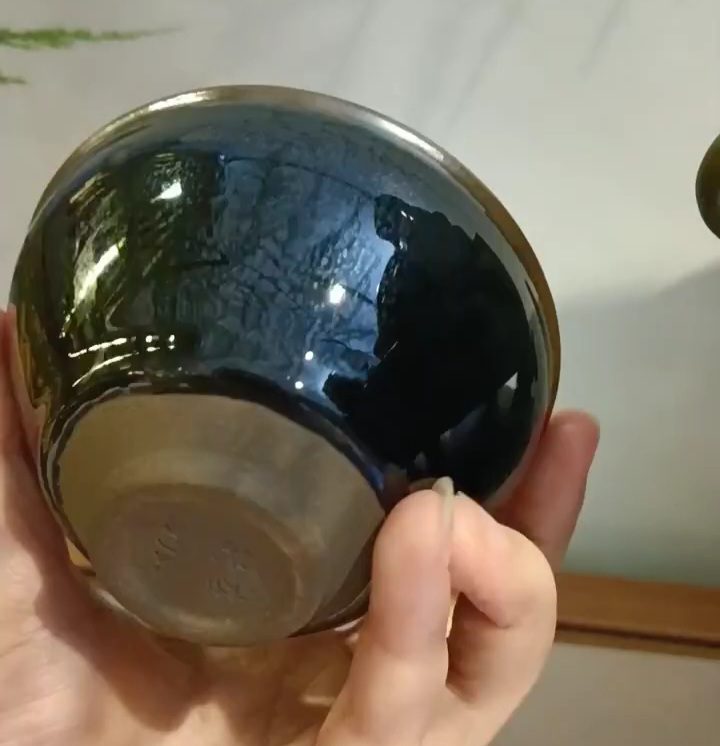
The bowl documented on this page is identified on its accompanying material as 鹧鸪斑, commonly translated in Jian ware collecting as partridge spot or partridge feather.
The piece has a dark glossy ground covered with pale rounded markings across the interior, producing the dense spotted appearance associated with this terminology.


Certificate and Attribution
The accompanying certificate identifies the artist as Li Ximei 李细妹 and also includes the art name Li Xinhong 李欣红.
The work name is given as 鹧鸪斑. The documentation also connects the piece with Kaihe Kiln.
Certificates are useful attribution evidence, but they are best considered together with the vessel itself, its base mark, provenance, purchase history, workmanship, and comparison with documented examples.

Why Li Ximei Is Important to the Modern Revival
Li Ximei’s place in contemporary Jian ware is supported by several different parts of her career: decades of firing experimentation, documented technical work, her association with Kaihe Kiln, recognition as a representative inheritor, and the visibility of works such as Wan Shan Ke Ran.
Her work is particularly useful when studying how contemporary Jianyang artists have continued traditional Jian ware glaze families while also developing new kiln-transmutation effects and individual approaches to firing.
Research Notes
Information about Li Ximei appears across government and intangible-cultural-heritage records, patent documentation, Kaihe Kiln material, interviews, commercial biographies, auction reporting, and collector sources.
Some promotional biographies use broader titles or make stronger historical claims than official records support. For that reason, this profile gives greater weight to government, heritage, patent, and other documentary sources when they differ from commercial descriptions.
Works in the FSOC Archive
Explore collection posts and reference images associated with Li Ximei and her work.
References & Further Reading
-
China Intangible Cultural Heritage Network — Jian Kiln Jian Ware Firing Technique
-
Nanping municipal-level intangible cultural heritage inheritor records
-
Fujian Provincial Government — Jian ware revival history
-
Patent CN108439953B — Traditional black-glazed silver oil-drop Jian ware firing method
-
China Intangible Cultural Heritage Network — contemporary Jian ware and Wan Shan Ke Ran