
Crackle & Crazing in Jian Zhan
建盏开片 · Kāipiàn
Why Jian Zhan glazes crackle, why tea can make the lines darker,
how crackle seasoning differs from ordinary 养盏, what your cup can
and cannot tell you, and when a beautiful glaze network becomes a care concern.
开片 (kāipiàn) is a network of cracks in a fired glaze.
The most important cause is stress created when the glaze and ceramic body do not expand
and contract in exactly the same way. Crackle may be visible immediately after firing,
or additional lines may become visible later.
[1]
[2]
Tea can darken or emphasize these fissures. That is a different phenomenon from the
more mysterious rainbow-like surface changes discussed on our general Jian Zhan
seasoning page.
[5]
[6]
A crackle pattern in the glaze is also different from a structural fracture through
the ceramic body. The two should never be treated as interchangeable.
First, What Does 开片 Mean?
In Chinese ceramic terminology, 开片 (kāipiàn)
refers broadly to cracking in the glaze layer. The Palace Museum describes it as a
natural glaze-cracking phenomenon that originally counted as a firing defect, but which
ceramic makers later learned to control and use deliberately as decoration.
[3]
English ceramic literature often makes a useful distinction:
The technical term commonly used when the glaze cracks because it is under tensile stress.
In functional ceramics this is often treated as a glaze defect.
The same basic cracking phenomenon when it is intentionally produced or aesthetically valued.
The broader Chinese ceramic term. Context determines whether the crackle was accidental,
accepted, cultivated, or deliberately decorative.
冰裂纹, or “ice-crack pattern,” is commonly used for crackle that resembles
fractured ice. 金丝铁线, “gold thread and iron wire,” is a much more specific
term associated with the differently colored crack networks of traditional Ge ware.
It should not be used as a generic name for every crackled Jian Zhan.
[3]
Crackle Is Not the Same as a Broken Bowl
A glaze craze is a fracture in the glassy glaze layer. A structural crack extends into
or through the ceramic body itself.
- web, polygon, ring, or ice-like network
- many lines rather than one isolated fracture
- lines may darken after tea use
- bowl remains physically intact
- one line continues through the clay body or foot
- matching fracture is visible inside and outside
- liquid seeps or leaks through the wall
- edge movement, flaking, or sharp fracture surfaces appear
Appearance alone cannot always tell you how deeply a crack travels. A leaking,
flaking, or obviously body-deep crack should be treated as structural damage rather
than decorative 开片.
Why Does a Glaze Crackle?
The glaze and the ceramic body are different materials. They expand when heated and
contract when cooled, but not necessarily by the same amount.
If the fired glaze ends up under enough tensile stress, it relieves some of that stress
by cracking.
Modern modeling of ceramic glaze cracking confirms that the difference between the
thermal-expansion behavior of the glaze and the ceramic body is a major driver of crack
formation. Glaze thickness, body thickness, temperature difference, cooling behavior,
and expansion coefficients all influence the final crack network.
[1]
Research on ancient Chinese crackled ceramics likewise found that relative glaze/body
thickness, firing temperature, and firing atmosphere help determine the morphology of
crack patterns.
[2]
Crackle is fundamentally a mechanical stress phenomenon in the glaze/body system.
It does not require tea to form.
Is Crazing a Defect or a Decoration?
The answer depends on the ceramic and the maker’s intention.
From an engineering perspective, crazing is often classified as a glaze-fit defect,
especially in functional tableware. ASTM even maintains a standardized thermal-shock
method specifically for evaluating resistance to crazing in fired glazed ceramics.
[4]
Artistically, however, Chinese ceramic makers turned the same phenomenon into a celebrated
decorative language. Song Guan and Ge wares are famous for intentionally valued crack networks.
Scientific analysis of ancient Chinese crackled ceramics confirms that these crack patterns
were influenced by manufacturing choices.
[2]
So a crackle pattern can be:
- an unwanted glaze-fit problem,
- a tolerated firing characteristic,
- an intentionally encouraged decorative feature, or
- a mixture of all three depending on the ceramic tradition.
Does Jian Zhan Really Develop 开片?
Yes. Crackle is documented in Jian ware, but it should not be treated as a defining feature
of every Jian glaze.
A Jianyang District Jian Kiln & Jian Zhan Association question-and-answer guide defines 开片,
explains that it may be natural or decorative, and specifically states that
Jian-kiln tea-dust glaze (茶末釉) can show crackle.
[7]
A separate Jianyang article illustrating historical Jian ware describes an early Northern
Song green-glazed bowl with clearly visible ring-like crackle and notes that this form of
开片 is commonly seen on green-glazed bowls.
[8]
Hare’s-fur, oil-spot, and other classic black crystalline Jian glazes should not be
described as “crackle glazes” merely because an individual bowl happens to craze.
Crackle is present in Jian history, but it is not the defining decorative principle
of the entire tradition.
Can New Crackle Appear After the Bowl Leaves the Kiln?
Yes.
Some craze networks are already present when a ceramic cools. Others become visible
later as residual stresses are redistributed or as the vessel experiences additional
thermal and environmental cycles.
Conservation guidance notes that crazing may be visible immediately after firing or may
appear long afterwards. Abrupt thermal changes are also specifically used in standardized
testing to reveal inadequate crazing resistance.
[4]
[9]
That means a collector can genuinely discover more crackle lines after weeks or months
of use.
Some lines may already exist and simply become easier to see after tea, minerals,
moisture, or dirt enter the fissures. “I can see more cracks now” does not automatically
mean “all of these cracks formed recently.”
Why Does Tea Make Crackle Darker?
This part is much easier to explain than ordinary Jian rainbow seasoning.
A craze line is a physical break in the otherwise glassy glaze surface. Depending on its
depth, the fissure may expose deeper glaze layers, the glaze/body interface, or even
porous ceramic beneath the glaze.
Conservation guidance specifically notes that crazing can allow food and other materials
to seep through breaks in a glaze and stain the ceramic beneath.
[9]
Tea contains colored organic compounds and is brewed in mineral-bearing water. Repeated
wetting, drying, oxidation, and deposition can therefore make existing fissures progressively
darker and easier to see.
Cracks provide pathways and recesses where staining material can collect, and crackled
ceramics are more susceptible to visible staining than an intact glassy surface.
Tea Has Historically Been Used to Color Crackle
This is not just a modern tea-table trick.
The British Museum describes a Ming porcelain ewer with broad brown crackle and notes
that imitation crackle coloration could be produced by staining with an iron solution
or with tea, a method the museum says was popularly
employed during the Qing dynasty.
[5]
Research on Guan and Ge wares also documents deliberately colored crack networks.
In Ge ware, large cracks may appear dark while smaller cracks appear gold-brown.
[2]
This does not prove that every modern Jian crackle line was deliberately stained,
but it gives us strong historical evidence for the basic phenomenon:
tea can be used to make glaze crackle visually prominent.
FSOC Case Study: Wu Jingen Glow Cup
The Wu Jingen glow cup documented in the FSOC collection gives us an unusually useful
before-and-after example because photographs exist from before regular seasoning and
again after the crack network became much more visible.
[10]
In the earlier photographs, the pale glaze looks relatively quiet at normal viewing distance.
But close-up photographs already reveal broad, faint polygonal boundaries in the glaze.
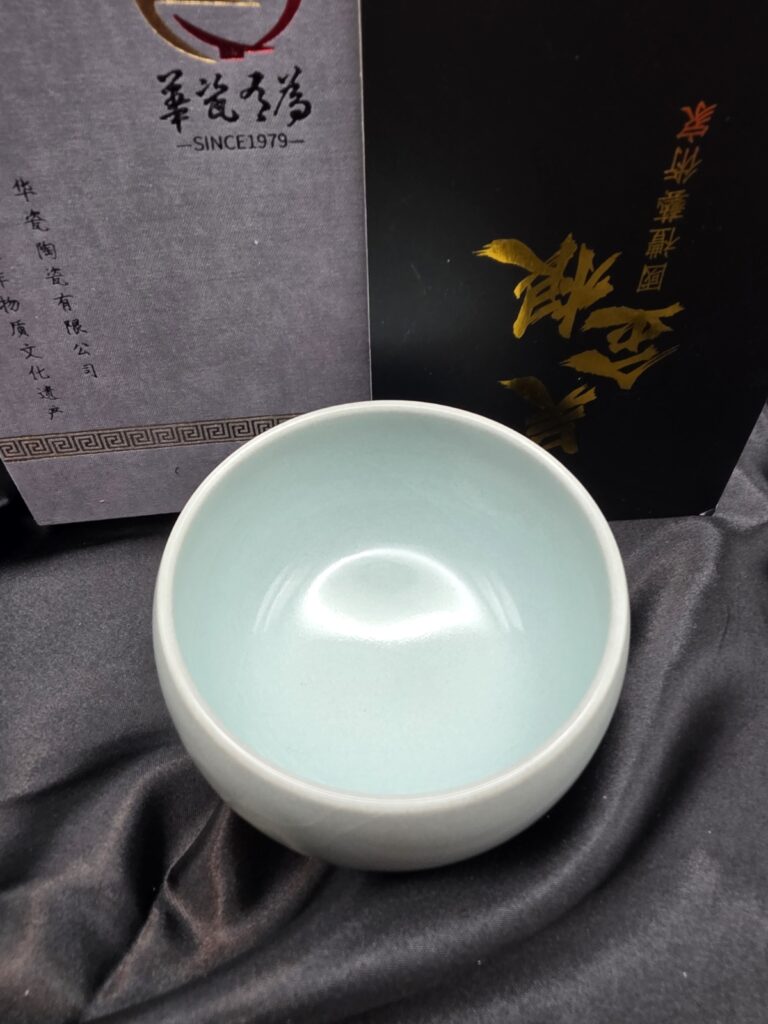
At normal viewing distance the crackle network is easy to miss.
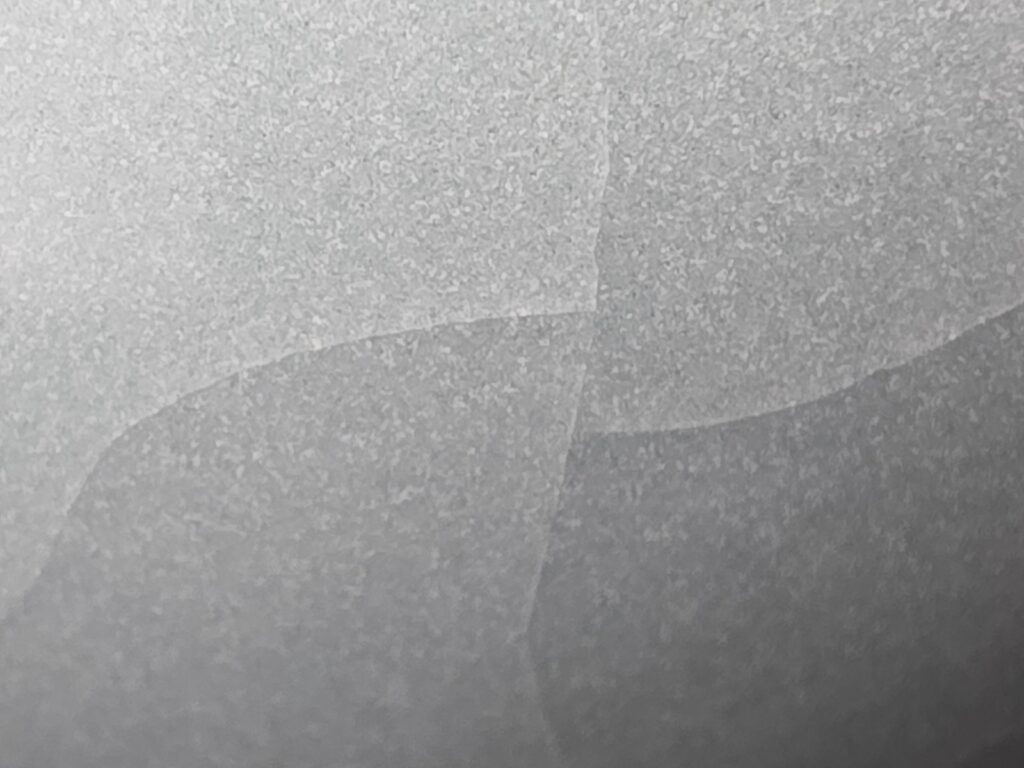
Faint broad boundaries are already visible within the glaze.
In the later photographs labeled “after seasoning,” the network is dramatically easier
to see. Dark material follows the fissures, giving the pale glaze a bold, map-like pattern.
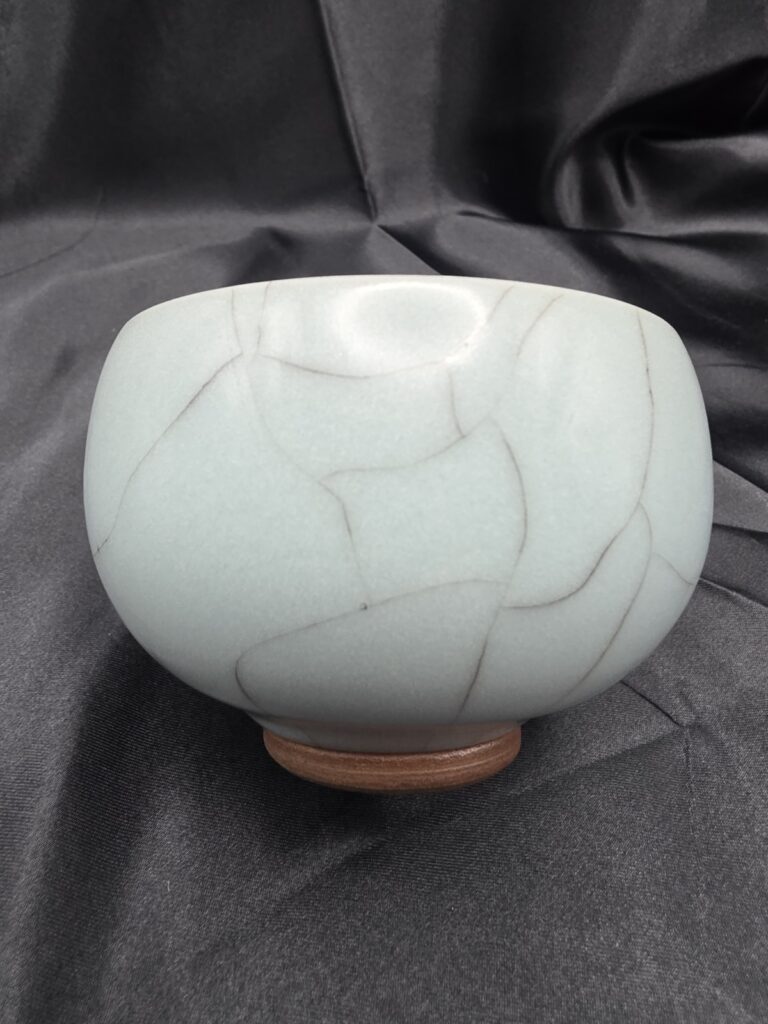
The crack network is now clearly visible across the bowl.
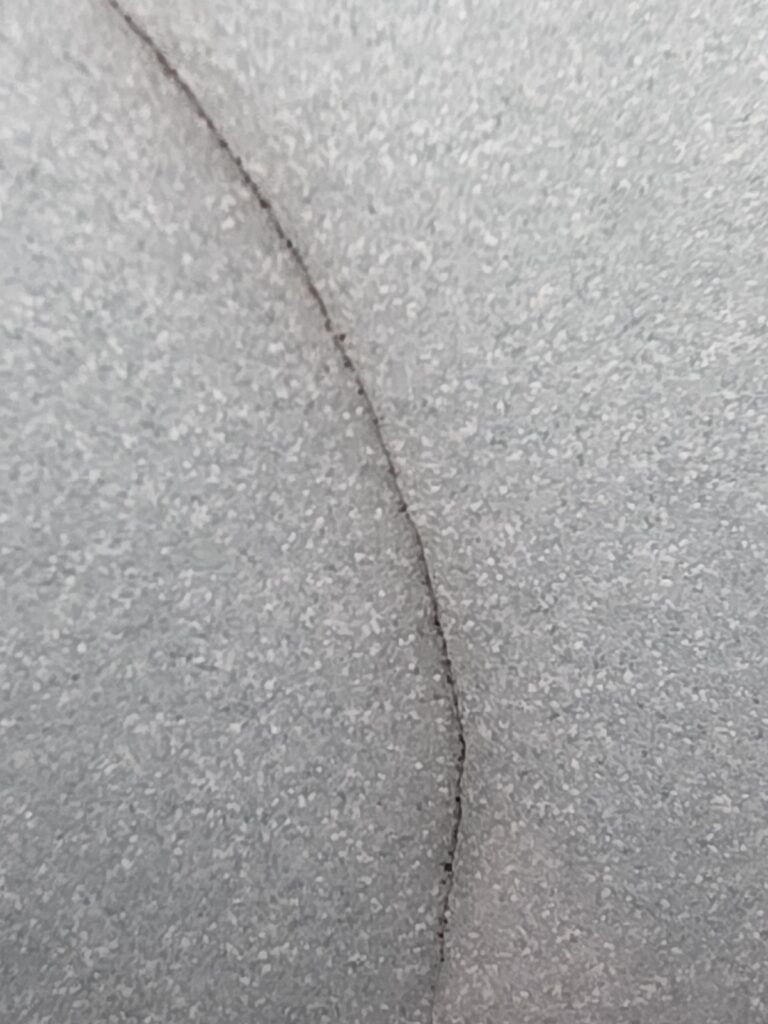
Dark material is concentrated along the fissure.
The glow makes the contrast even clearer
Under luminescent conditions, the glaze becomes bright blue while the crack network remains
comparatively dark. This greatly increases the visual contrast of the lines.
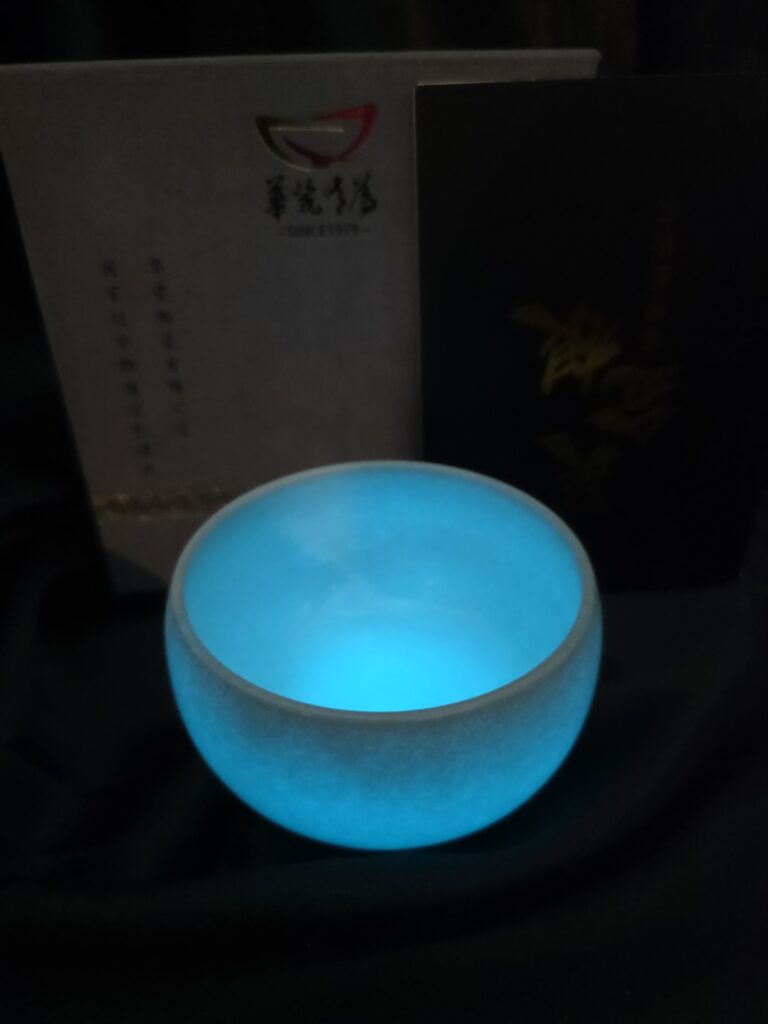
The bowl glows strongly while the crack network remains difficult to distinguish.
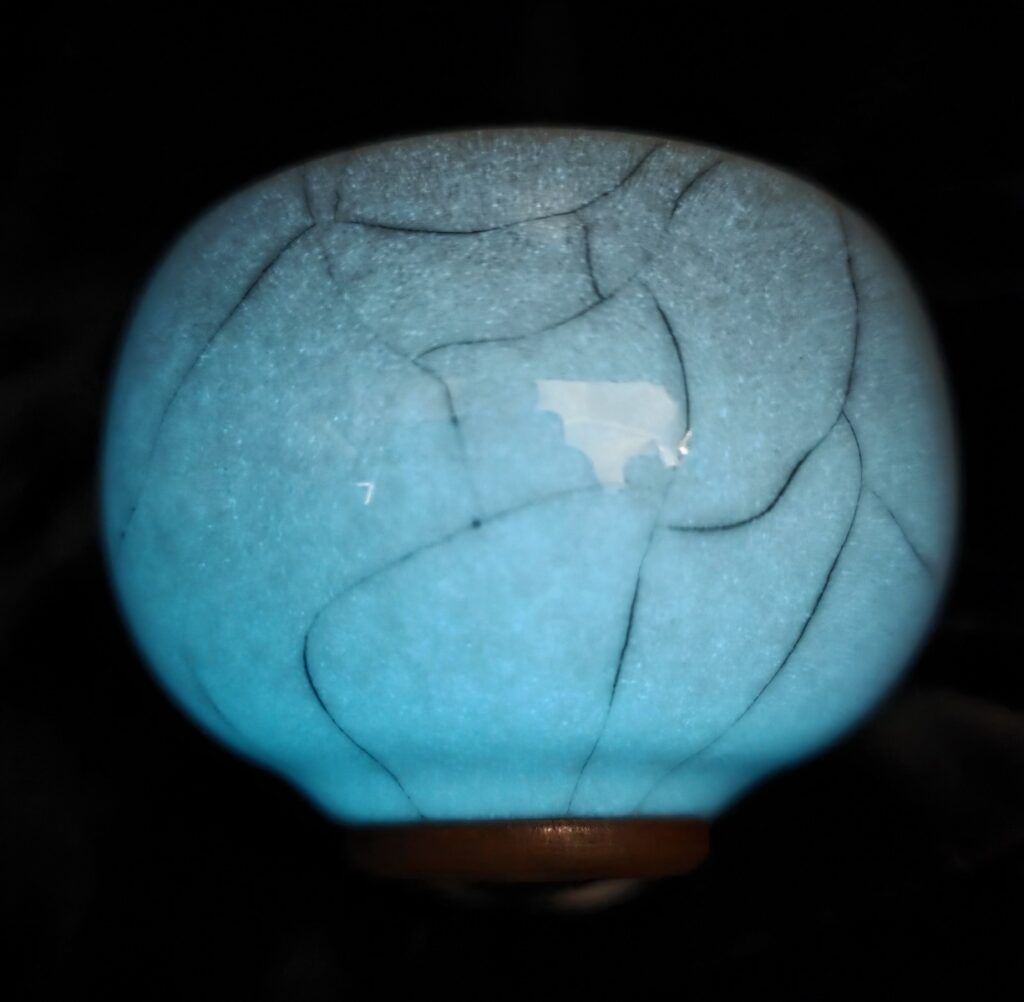
The dark crack network now stands out strongly against the luminous glaze.
- crackle can be present before it is obvious at normal viewing distance,
- use can make an existing craze network dramatically easier to see,
- dark material can concentrate along the fissures, and
- lighting and the glow effect can greatly change how strongly the lines appear.
They do not let us determine the exact date that every individual crack formed.
Some lines may have existed faintly before use, some may have developed later,
and some may simply have become more visible as they stained.
Crackle Seasoning Is Different From Ordinary Jian Seasoning
On an intact glaze, the changes collectors call 养彩 or 七彩光 may involve very thin
surface deposits, changes in reflectivity, the pre-existing optical behavior of the fired
glaze, or some combination that has not yet been fully studied.
Crackle seasoning gives us an additional, much more obvious pathway:
the glaze already contains physical fissures that can become stained.
Surface changes may be subtle and their exact mechanism remains incompletely studied.
Existing physical fissures can trap or transmit staining material, making the network darker.
Should You Force More Crackle With Hot-and-Cold Cycling?
We do not recommend it.
Sudden temperature changes can promote or reveal crazing. In fact, thermal shock is
deliberately used in standardized ceramic testing to evaluate crazing resistance.
[4]
Laboratory research on tableware porcelain has also produced crack networks by repeated
thermal-shock cycling.
[11]
Alternating very hot and very cold conditions may indeed encourage additional crack formation.
That is exactly why FSOC does not recommend using extreme thermal shock simply to obtain a
more dramatic crackle pattern.
Normal tea use already exposes a vessel to repeated warming and cooling. There is no need
to add ice-water shocks, freezer treatments, or other extreme temperature cycling.
What About Hygiene and Food Safety?
This is where crackle-glazed functional ware deserves more caution than an intact glossy glaze.
A crazed surface contains recesses that are more difficult to clean. Conservation literature
notes that breaks in glaze can permit staining materials to reach the ceramic beneath.
[9]
A small controlled experiment published in Ceramics Monthly deliberately contaminated
crazed and non-crazed glazed tiles with bacteria. The crazed samples retained recoverable
bacteria after several lighter cleaning treatments. In that experiment, a high-temperature
dishwasher protocol eliminated detectable colonies.
[12]
A separate academic study of tableware porcelain likewise notes that crazed surfaces can
harbor bacteria and recommends caution for food-contact use.
[11]
The studies above did not test your individual bowl, your individual glaze chemistry,
or your normal tea routine. They do show why we should not treat intentionally preserving
old tea residue inside craze lines as harmless by default.
FSOC cannot certify a crazed vessel as food-safe from appearance alone. Food-contact safety
depends on the glaze chemistry, firing maturity, depth of the fissures, body porosity,
contaminants, and cleaning routine.
Antique pieces, chemically aged pieces, unknown glazes, and vessels showing glaze flaking,
persistent odor, mold, seepage, or body-deep cracks deserve substantially more caution.
How Should a Crackle-Glazed Jian Zhan Be Cleaned?
For ordinary tea sessions, rinse promptly rather than allowing old tea to sit and dry for
long periods.
- Empty the tea when the session is finished.
- Rinse with clean warm water.
- Gently wipe accessible glazed surfaces with a clean soft cloth or sponge if needed.
- Rinse again and allow the bowl to dry thoroughly, including the exposed foot.
-
If residue, odor, or contamination remains, prioritize cleanliness over preserving
dark seasoning lines and follow the maker’s food-contact cleaning instructions.
FSOC does not recommend routinely packing wet tea leaves into crackle lines, leaving stale
tea overnight, or deliberately allowing heavy tea scale to build simply to darken the pattern.
This page also does not recommend abrasive powders, metal scrubbers, bleach, acids,
or aggressive chemical treatments.
The general FSOC seasoning guide takes a conservative water-first approach for Jian Zhan.
With a heavily crazed functional surface, however, hygiene can become a competing concern.
If the maker specifically permits a mild unscented detergent and ordinary rinsing is not
removing contamination, preserving seasoning should not take priority over cleanliness.
Should You Intentionally Darken the Crackle?
Historically, colored crack networks are part of Chinese ceramic aesthetics, and tea has
indeed been used to emphasize crackle.
[5]
But for a functional Jian Zhan, there is an important difference between letting crackle
develop naturally through ordinary use and deliberately loading the fissures with old tea.
Our recommendation is simple:
use the cup normally and let the lines develop at their own pace.
That produces a more meaningful record of actual use and avoids confusing ordinary
deposits with deliberate artificial staining.
Crackle Is Not Proof of Age
This is particularly important for collectors of antique Jian ware.
The Jianyang District Jian Kiln & Jian Zhan Association notes that some excavated old
Jian pieces may develop crackle after exposure to air, but it also warns that new pieces
can be artificially aged with acidic chemical treatments that alter the glaze and create
age-like surface effects.
[7]
“It has old-looking crackle” is not an authentication method.
Crackle pattern, darkened fissures, and aged-looking glaze must be evaluated alongside
body, foot, firing characteristics, excavation history, provenance, and other evidence.
Do not attempt chemical aging yourself. Strong acids used in fraudulent aging practices
can permanently damage glaze and pose serious safety hazards.
If More Lines Appear, Is the Bowl Failing?
Not necessarily.
Glaze crazing can continue or become more visible without the ceramic body itself breaking.
A network of superficial glaze cracks can remain mechanically separate from a structural
body fracture.
At the same time, a growing crack network tells us that stresses exist in the glaze/body
system. That is a reason to avoid unnecessary thermal shock and to keep an eye on the vessel.
- more fine glaze lines becoming visible
- darkening of existing lines
- no leakage
- no glaze lifting or sharp edges
- liquid seeps through the wall
- a crack crosses the clay body or foot
- glaze begins flaking or lifting
- persistent odor, mold, or contamination remains
- a sharp edge or structural separation appears
Crackle Claims: Checked
Incorrect. Glaze crazing and structural body cracks are different phenomena.
Supported by ceramic conservation, historical practice, and direct observation.
Not necessarily. Existing faint cracks can become dramatically more visible after staining.
False. Both natural delayed crazing and artificial aging exist.
False. Crackle occurs in some Jian glazes and examples but is not universal.
Not recommended. Thermal shock is literally used to provoke and test crazing.
No. Crack-line staining has a clear physical pathway that ordinary rainbow seasoning may not share.
How to Document Crackle Development
If you have a crackle-glazed Jian Zhan, photographs taken from the beginning can answer
questions that memory cannot.
Photograph before regular tea use.
Repeat under the same lighting.
Compare both full bowl and close-up images.
Look for new lines versus darker old lines.
Use the same viewing angle, light source, and camera when possible. Include both dry and
freshly rinsed photographs because wetting can temporarily make craze lines more visible.
If the glaze is luminescent, fluorescent, highly reflective, or color-shifting, photograph
it under both ordinary and special lighting. Different lighting can turn a faint glaze network
into a dramatic black map without any physical change occurring at that moment.
The Best Way to Think About Crackle Seasoning
Crackle seasoning is not simply “tea changing the glaze.”
A better model is:
The kiln creates the stressed glaze and its fissures. Time and use may create or reveal
additional crackle. Tea then makes some of those pathways more visible through staining
and deposition.
That model explains why an apparently plain bowl can gradually develop a dramatic network
without requiring us to pretend that every dark line formed from scratch during seasoning.
It also explains why crackle-glazed Jian Zhan deserve care advice of their own.
This is Part Two of the FSOC Seasoning Guide
For ordinary Jian Zhan without an obvious craze network, read our deeper guide to
养盏, tea deposits, 七彩光, water chemistry, and common seasoning myths.
References & Further Reading
The sources below are separated by purpose. Scientific and conservation sources explain
crack mechanics and care. Jianyang sources document Jian-specific examples and terminology.
The FSOC collection record is included as a documented modern case study.
of thermal expansion, glaze thickness, body thickness, temperature difference, and cooling.
firing temperature, and atmosphere influence crack-pattern morphology. Also discusses
the deliberately colored crack networks of Guan and Ge wares.
decorative, and explains the specific Ge-ware term 金丝铁线.
stress and that abrupt thermal changes can reveal inadequate resistance to crazing.
or with tea, a method popularly employed during the Qing dynasty.
why repeated tea contact can leave persistent organic/mineral staining, although it did
not specifically study crackle-glazed Jian Zhan.
and warning that both environmental change and artificial chemical aging can create
age-like crackle effects.
and states that this crackle morphology is commonly seen in green-glazed Jian bowls.
the ceramic body to staining by food and other materials.
and the later darkened crack network used as the case study on this page.
networks in glazed tableware porcelain and discussing the cleaning implications of crazed surfaces.
non-crazed glazed tiles. Useful evidence that fissures complicate cleaning, but not a
blanket food-safety certification or condemnation of every crackle-glazed vessel.
Research on glaze cracking is much stronger than research on modern Jian Zhan seasoning.
We can explain why craze networks form and why fissures are susceptible to staining with
considerably more confidence than we can explain every example of 七彩光 on an intact Jian glaze.
Where a statement on this page comes from collector observation rather than controlled
Jian-specific research, Fifty Shades of Clay identifies that distinction rather than
converting a plausible explanation into a scientific fact.