
Pan Jiacai · 潘家财
Contemporary Jian Ware Maker · Dragon-Kiln Wood-Fired Works
Quick Facts
潘家财
Pan Jiacai
Jian Ware · 建盏
Wood firing · Dragon-kiln association
At least the late 2010s to present
Nanping City Arts & Crafts Master
Jianyang / Nanping association
Biography
Pan Jiacai (潘家财) is a contemporary Jian ware maker associated with
wood-fired production and dark, iron-rich Jian glazes. His work has
circulated in the collector market for a number of years, with surviving
examples accompanied by branded presentation boxes, certificates and
maker identification.
Public biographical information about Pan remains limited. Details such as
his birth year, early training and complete workshop history have not yet
been located in reliable primary sources. Physical examples of his work,
however, provide considerably more information about his firing practice
and ceramic style.
Collector and marketplace sources identify Pan as a student of
Xiong Zhonggui (熊忠贵)
,
a noted Jian ware maker associated with traditional wood firing. The
relationship is reported in secondary sources and is retained here with
that attribution.
Dragon-Kiln Wood Firing · 龙窑柴烧
One of the clearest pieces of documentation connected with Pan Jiacai is
the presentation packaging accompanying a surviving bowl.
The box prominently carries the name
潘家财 together with
龙窑柴烧, literally
“dragon-kiln wood firing.”
The Roman-letter form PANJIA CAI also appears on the
packaging.
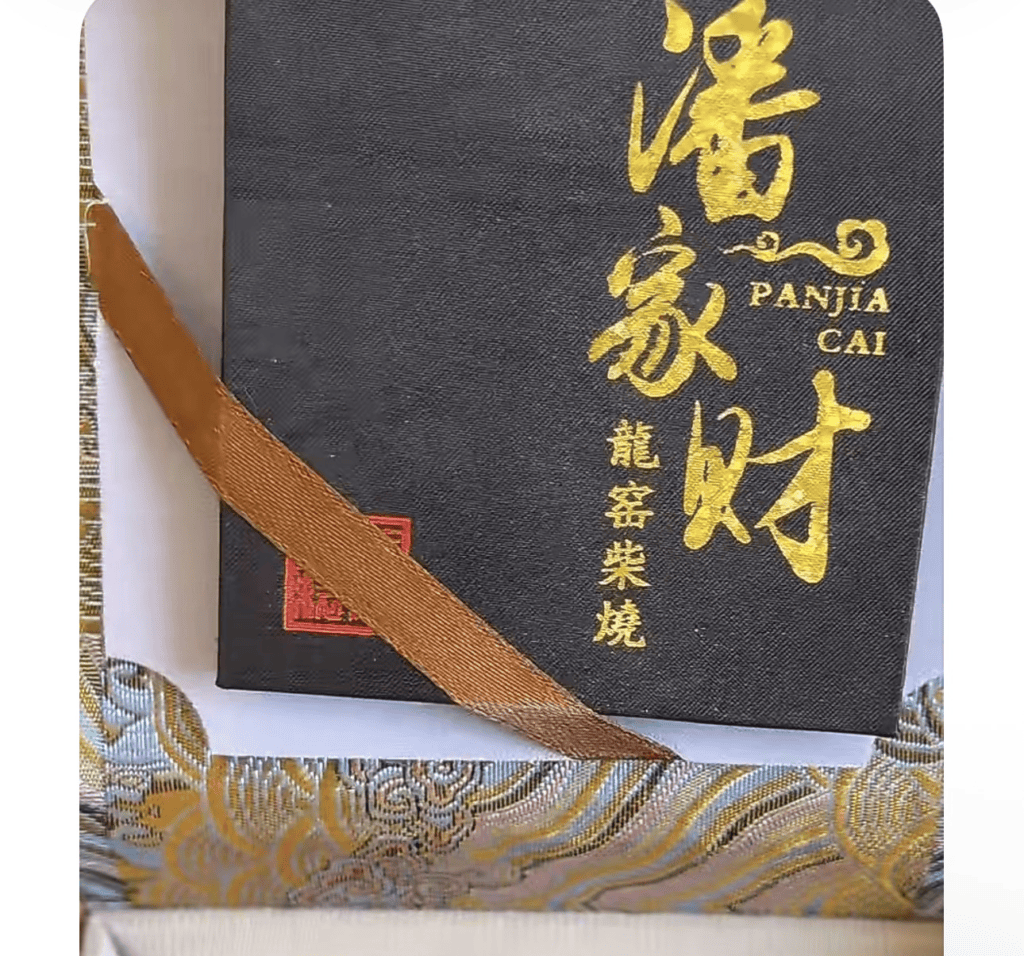
Presentation box marked 潘家财 and 龙窑柴烧.
This provides strong evidence that at least part of Pan Jiacai’s work is
intentionally represented as dragon-kiln wood-fired Jian ware.
Secondary marketplace material has also associated Pan’s name with
书坊龙窑, or “Shufang Dragon Kiln.” At present,
however, there is not enough reliable documentation to determine whether
Pan personally owns this kiln, works from it, commissions firings there,
or participates in group firings.
Until stronger documentation is located, Fifty Shades of Clay describes
Pan as associated with dragon-kiln wood firing rather
than identifying a particular dragon kiln as his personal kiln.
Glazes & Visual Character
Pan Jiacai’s documented work is centered on the dark iron-rich glaze
tradition characteristic of Jian ware. Surfaces associated with his work
range from relatively restrained black and charcoal appearances to
considerably more active metallic, silver, blue and iridescent effects
under direct illumination.
The documented bowl shown on this page contains extremely fine streaks,
specks and crystalline activity over a dark glaze ground. Much of this
activity becomes dramatically more visible when the bowl is tilted into
strong light.
As with traditional Jian ware, these effects develop during firing through
the behavior of the iron-rich glaze, atmosphere, temperature and cooling
conditions. They are not painted decoration.
Documented Glaze Terms
Material supplied with Pan Jiacai pieces and marketplace records associated
with his work use a number of glaze and pattern names. These include:
Blue Hare’s Fur
Colored Hare’s Fur
Retro Hare’s Fur
Wood-Fired Yaobian
Other commercial names connected with Pan’s bowls have included
“Golden Autumn,” “Golden Shell,” “Moon-Eye Gradient Hare’s Fur”
and “Plum Blossom Braving the Snow.”
These names are useful for documenting how Pan’s pieces are described and
sold, but contemporary commercial glaze names are not necessarily formal
or standardized Jian ware classifications.
Documented Collector Example
The example documented for this profile is especially useful because the
bowl can be studied together with its presentation packaging, certificate
and foot.
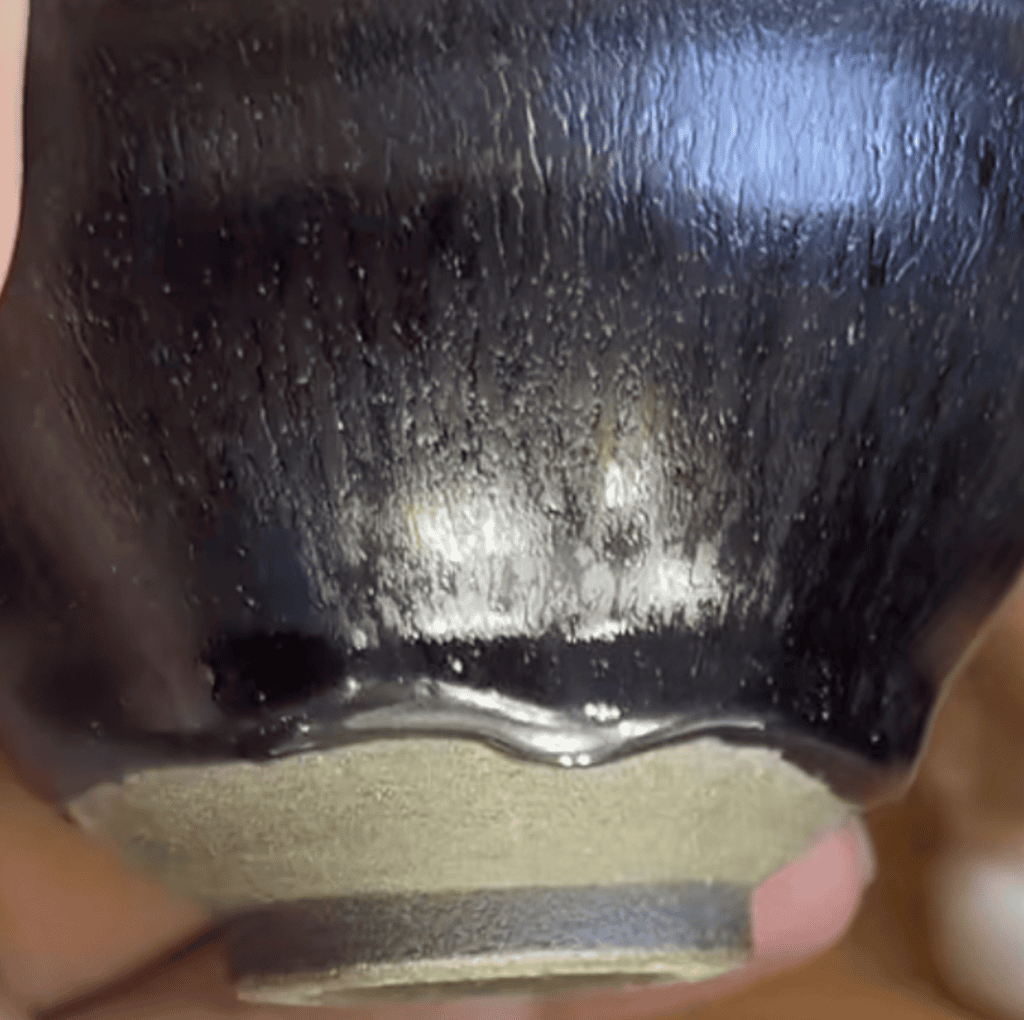
The exterior shows a glossy black glaze terminating above the lower body,
leaving the iron-rich clay exposed around the foot. Fine vertical and
slightly irregular streaking is visible through the dark glaze.
Exterior glaze and exposed lower body of the documented example.
Foot & Maker Identification
The underside provides another important reference point for identifying
Pan Jiacai’s work.
The documented bowl has an exposed, dark gray iron-bearing clay body and a
recessed central foot area containing the maker’s mark. Recording the
underside is particularly valuable because boxes and certificates can
become separated from individual bowls over time.
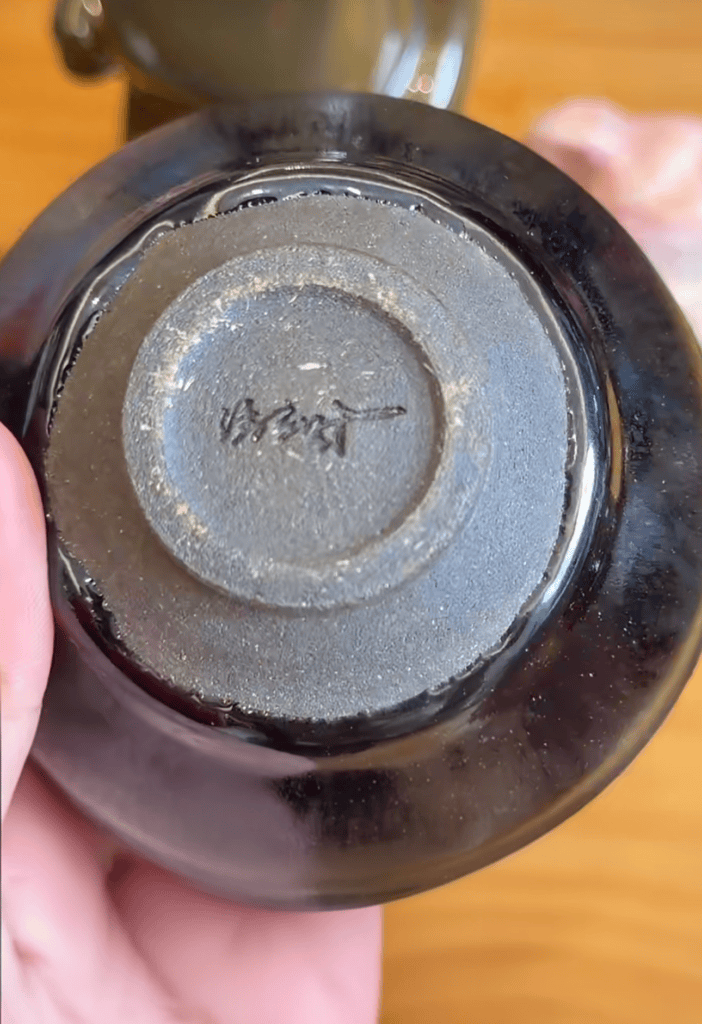
Foot and base identification of the documented Pan Jiacai example.
Collectors should compare the foot, mark, clay body, glaze, packaging and
certificate together when evaluating an attributed Pan Jiacai piece.
A base mark alone should not be treated as definitive authentication.
Certificate
The documented bowl is accompanied by a
收藏证书, or “Collection Certificate.”
The certificate includes an
作者签名
field for the artist’s signature, together with handwritten information
and a circular red seal.
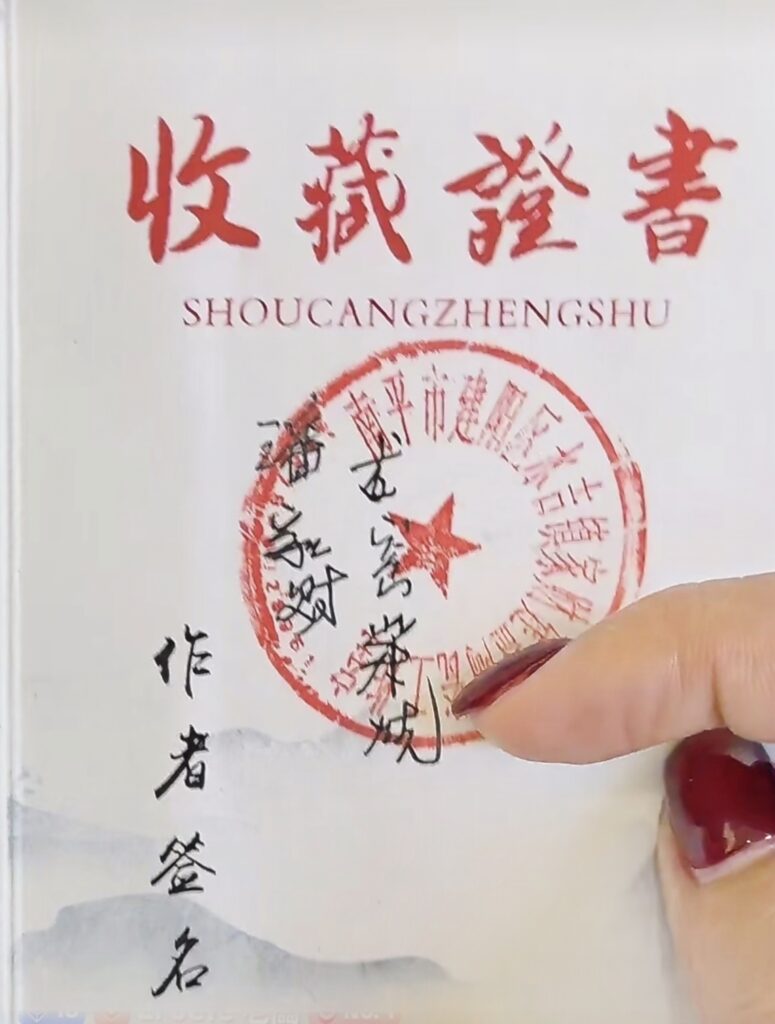
Collection certificate accompanying the documented example.
The circular seal appears to contain additional workshop or organizational
information, but the available photograph is not sufficiently clear to
confidently reconstruct the complete inscription.
The certificate is useful provenance linking the bowl with Pan Jiacai’s
name. As with most contemporary Jian ware certificates, it should be
considered part of the object’s maker or sales documentation rather than
an independent third-party authentication.
Reported Professional Title
Biographical and marketplace descriptions of Pan Jiacai identify him as a
南平市工艺美术大师,
commonly translated as
Nanping City Arts & Crafts Master.
This is a genuine type of municipal professional designation used in
Nanping, but Fifty Shades of Clay has not yet located an accessible
official list independently confirming Pan’s individual appointment.
The title is therefore included as a
reported credential rather than presented as
independently verified.
Identifying Pan Jiacai Pieces
Current documentation suggests that the strongest identification comes
from several features considered together:
- The name 潘家财 on presentation material.
- Packaging marked 龙窑柴烧.
- A corresponding collection certificate.
- Artist signature or maker identification.
- Photographs of the foot and base mark.
- The dark iron-bearing Jian clay body.
- Provenance connecting the bowl, box and certificate.
Packaging style can change over a maker’s career, so a bowl should not be
rejected simply because its box differs from the example documented here.
Likewise, packaging alone is not sufficient to establish authorship.
Research Status
Pan Jiacai is currently better documented through surviving ceramics and
collector material than through published biography.
No reliable birth year, detailed workshop history or ceramics patent has
yet been located. Searches for the name 潘家财 also return unrelated
individuals, making careful identification particularly important.
The exact relationship between Pan and the dragon kiln or kilns used to
fire his work also remains an area for further research.
This profile can be expanded as primary records, clearer workshop
information or additional signed examples become available.
Sources & Documentation
Pan Jiacai Jian ware bowl, presentation box marked 潘家财 and
龙窑柴烧, collection certificate, foot photograph and associated
documentation preserved in the Fifty Shades of Clay research archive.
Collector and marketplace sources identify Pan Jiacai as a student of
Xiong Zhonggui. For information about Xiong himself, see his separate
Fifty Shades of Clay research profile.
Research note: commercial and collector records are used to document
contemporary Jian ware where primary biographical sources are unavailable.
Claims that have not been independently verified are identified as
reported or attributed rather than stated as established fact.