Cai Bingkun 蔡炳昆
Jian Zhan Artist • Shuiji, Jianyang • Cai Family Tradition
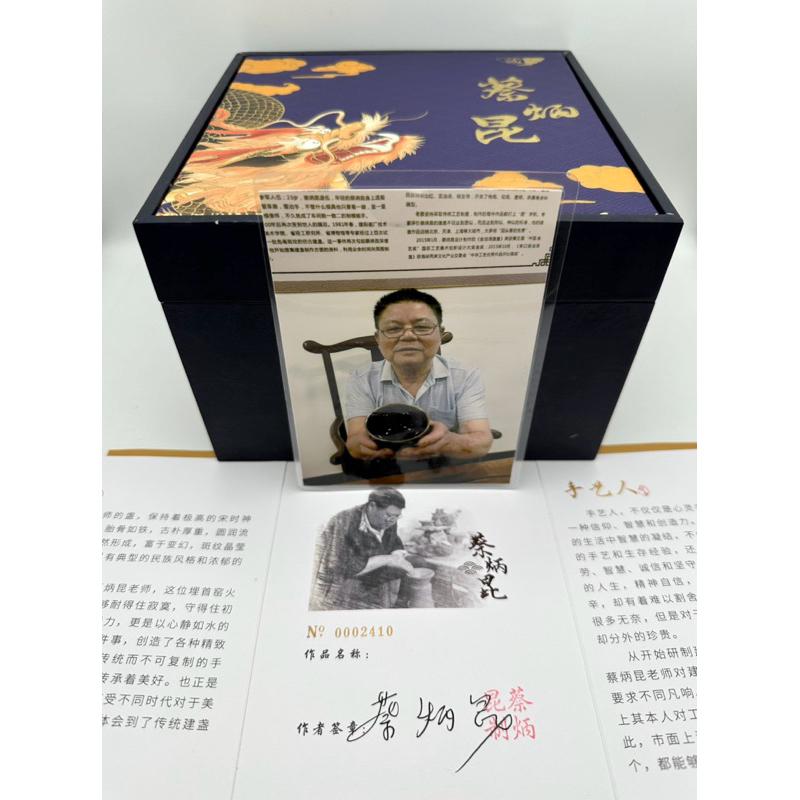
Cai Bingkun pictured with a Jian Zhan, presentation box, collector booklet and numbered documentation.
Quick Facts
About Cai Bingkun
Cai Bingkun (蔡炳昆) was born in
July 1949 in Houjing Village (后井村),
Shuiji Town, in present-day Jianyang District of Nanping,
Fujian Province.
He grew up within the historic Jian kiln region. Local reporting
describes Cai finding fragments of old black-glazed ceramics while
playing and gathering firewood around the area as a child, while older
generations told stories about the former Jian kilns and their famous wares.
Cai was one of seven children. His father was a traditional potter,
and when Cai was approximately 13 years old he began
formally learning pottery from him.
His training included selecting and preparing clay, refining the body,
wheel throwing, glazing and making practical ceramic vessels.
Wheel throwing became a particular strength. Contemporary accounts state
that by the age of 16 he had become skilled in the full range of pottery
work and was assisting his father regularly.
Early Career
At 19, Cai entered military service.
After leaving the military, he returned to Jianyang in
1972 and was assigned to work at the
Jianyang Compressor Factory.
There he became a skilled mold-making technician.
Local accounts describe him as particularly capable at examining
an object, taking its measurements and reproducing its form accurately.
Although industrial work became his regular occupation,
the pottery skills learned from his father remained important when
he later returned to ceramics.
Return to Jian Zhan
In 1981, Cai returned to Shuiji and saw the results
of experimental work that had successfully reproduced traditional
rabbit-hair Jian Zhan after centuries in which the historic ware
had no longer been produced locally.
The revival renewed his interest in the Jian ware that had surrounded
his childhood.
In 1989, after his younger brothers
Cai Binglong and Cai Bingsheng had established Jian Zhan workshops,
the brothers began collecting information about Jian Zhan production
and learning from craftspeople working in the revived field.
By 1995, Cai Bingkun was conducting his own Jian Zhan
research and firing experiments during his free time while remaining
employed at the factory.
His earlier pottery experience meant that wheel throwing and glaze
preparation were already familiar. The greater challenge was controlling
firing temperature and the crystallization behavior of Jian Zhan’s
iron-rich black glaze.
Jianyang reporting specifically records Cai using an
electric kiln during these experiments.
After more than ten firings, he successfully produced a batch of
rabbit-hair Jian Zhan.
In 2004, at approximately 55 years old,
Cai retired from factory work and devoted himself fully to
Jian Zhan research and production.
The Cai Brothers
Cai Bingkun is the eldest of three brothers closely associated
with the modern revival of Jian Zhan.
Chinese reporting frequently refers to them together as the
Cai Brothers (蔡氏三兄弟).
Cai Bingkun 蔡炳昆
Eldest brother
Traditional pottery background and long-term research into
rabbit hair, oil spot and other Jian glaze effects.
Cai Binglong 蔡炳龙
Second brother
Known for a wide range of traditional Jian Zhan,
including rabbit hair, oil spot and other mineral-glaze effects.
Cai Bingsheng 蔡炳盛
Youngest brother
Jian Zhan craftsman, researcher and writer associated with
extensive study of glaze formation and firing.
Although they share the same family ceramic background,
each brother developed his own workshop practice, glaze research,
marks and artistic identity.
Cai Family Jian Zhan Workshop
Cai Bingkun established the
蔡氏建盏 workshop in Jianyang.
Local reporting places the workshop near the foot of
Baotashan on the southern side of the city.
It was described as a two-story building with racks filled with
unfired Jian Zhan blanks and active glazing and firing work underway.
Accounts of Cai’s working methods emphasize experimentation.
He studied local clay and mineral materials, glaze formulation,
kiln atmosphere and temperature, and reportedly collected unusual
clay samples when he encountered them so that he could test their
behavior in firing.
Glazes & Ceramic Work
Cai Bingkun’s documented work includes traditional Jian glaze
families together with more experimental crystalline and
kiln-transmutation effects.
Rabbit Hair
Blue Rabbit Hair
Oil Spot / Oil Drop
Silver Oil Spot
Pearl Spot
Variant Hare’s-Fur
Kiln Transmutation
Yaobian-Style Effects
Published interviews additionally associate Cai with
pearl-spot and imitation yaobian
Jian Zhan, while other reporting records blue rabbit hair,
silver oil spot and variant hare’s-fur among the glazes he developed.
His work extends beyond the traditional tea-bowl form.
Published accounts also document
meiping vases, flower vases, gaiwans and other tea wares.
Examples of Contemporary Work
Modern examples associated with Cai Bingkun show how widely
the surface of his Jian Zhan can vary beyond the classic
rabbit-hair and oil-spot patterns.
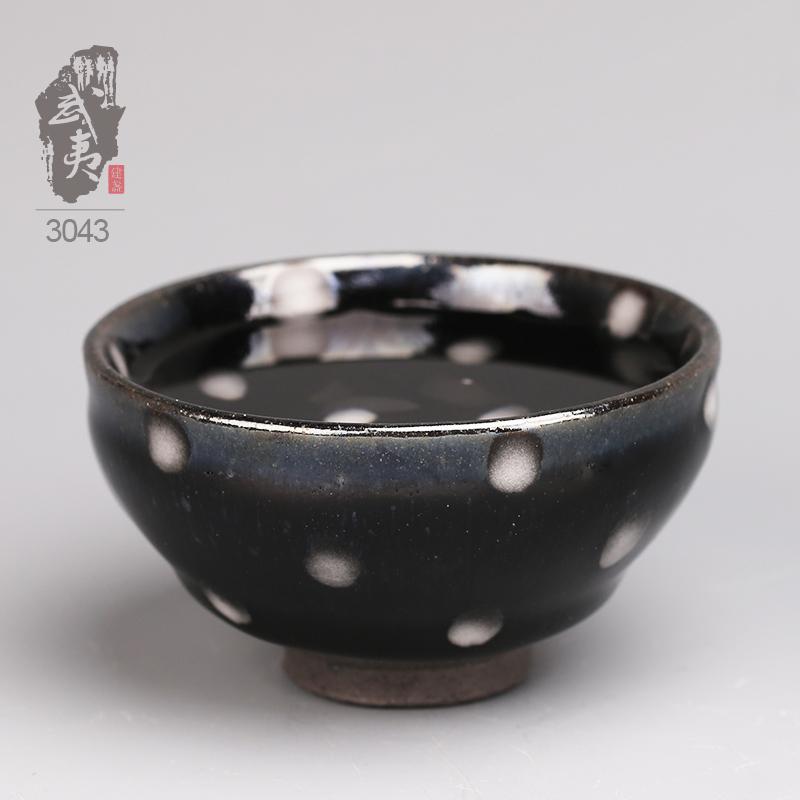
Dark-glazed Jian Zhan associated with Cai Bingkun,
displaying large pale crystalline spots.
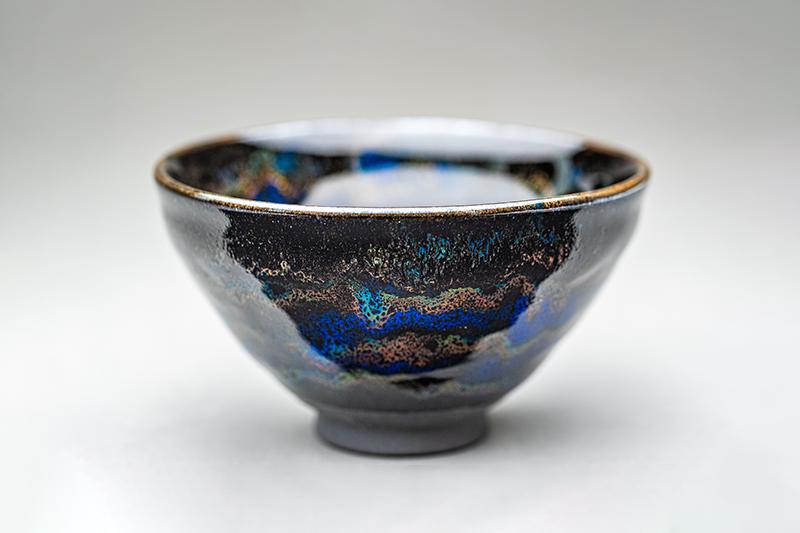
Contemporary work associated with Cai Bingkun,
showing vivid blue and iridescent kiln-transmutation effects.
Awards & Recognition
2015 Gold Award
In January 2015, a Cai Bingkun oil-spot Jian Zhan received a
Gold Award at the Third China
“Golden Arts Award” International Arts and Crafts
Innovation Design Competition.
Source wording:
Jianyang News records the work as
《油滴建盏》, while a later Sina reproduction
gives the title as 《金油滴建盏》.
2015 Silver Award
In October 2015, his:
《束口银油滴盏》
Constricted-Rim Silver Oil-Drop Jian Zhan
received a Silver Award in the
“Excellent Chinese Craft Works” competition associated with
the Cross-Strait Cultural Industries Fair.
Intangible Cultural Heritage Recognition
Cai Bingkun is officially recognized in connection with the
continuation of Jian Zhan craftsmanship in Jianyang.
Fifth Batch · Nanping Municipal-Level Representative Inheritor
The list announced by the Nanping Municipal People’s Government
on December 6, 2017 includes:
蔡炳昆 · 建盏制作技艺(建阳)
Cai Bingkun · Jian Zhan Making Techniques (Jianyang)
This is a municipal-level personal designation.
It should be distinguished from the broader national heritage status
of 建窑建盏烧制技艺,
Jian Kiln Jian Zhan Firing Technique, which is listed as a
National Intangible Cultural Heritage project.
Teaching & Lineage
Cai Bingkun’s first ceramic teacher was his father,
from whom he learned traditional pottery production beginning
at approximately 13 years old.
His later Jian Zhan development grew through his own experimentation,
cooperation with his brothers and study with craftspeople involved
in the revived Jian Zhan tradition.
Ye Yiyun 叶义云
Published biographical material for Jian Zhan craftsman
Ye Yiyun (叶义云) identifies Cai Bingkun as his teacher.
Ye is described as apprenticing under Cai and returning to fundamental
processes such as preparing clay, wheel throwing and controlling kiln firing.
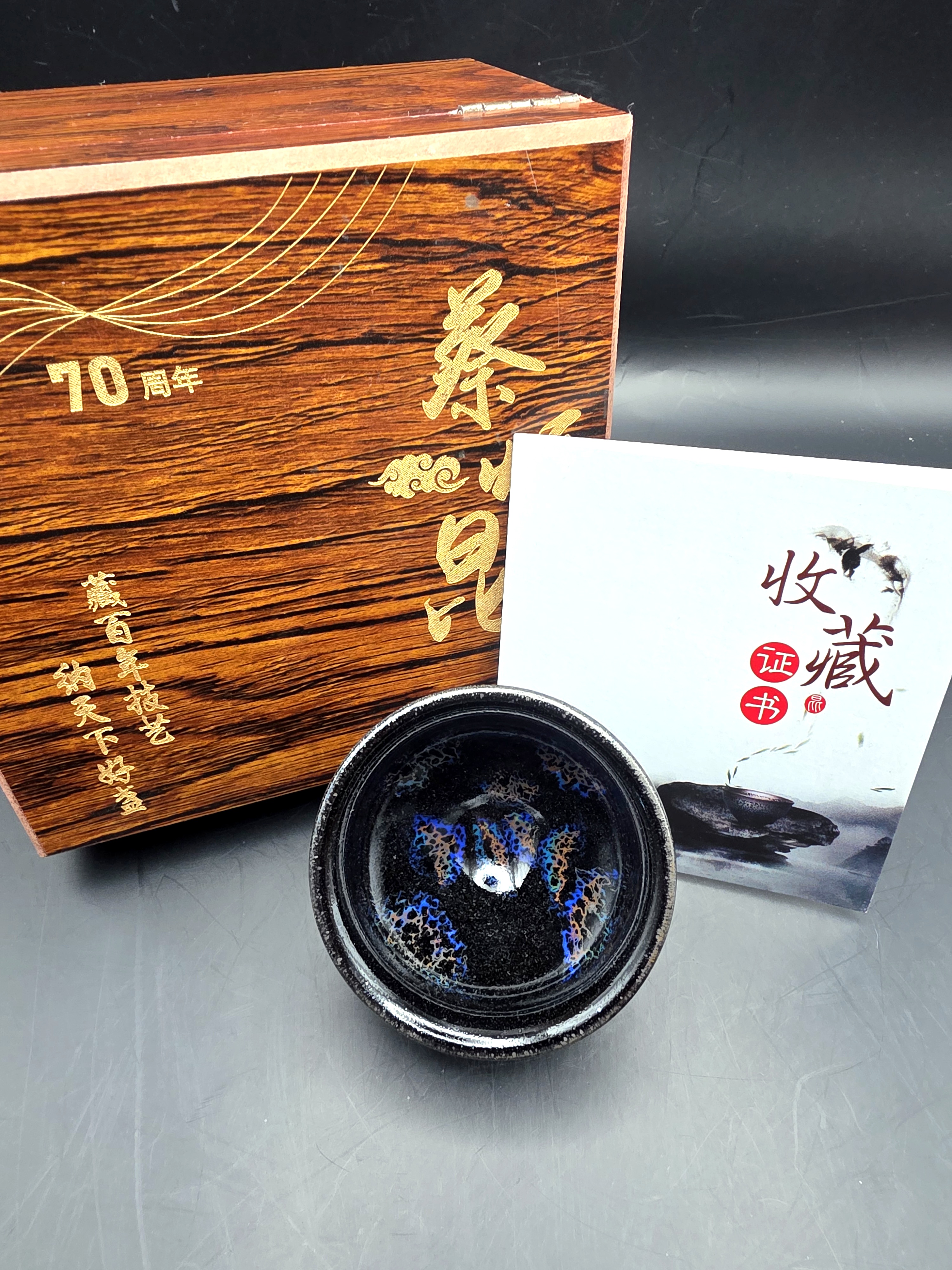
70th Commemorative Works
Collectors may encounter Cai Bingkun Jian Zhan carrying the inscription:
七十周年
This literally means “70th Anniversary”
or “70th Commemoration.”
Examples are encountered in the modern collector market as
70周年珍藏版, or “70th Anniversary Collector’s Edition.”
Cai was born in 1949, making 2019 his 70th year.
However, the inscription itself does not explain the exact event
being commemorated, and a primary workshop catalogue defining the
complete series has not yet been located.
Fifty Shades of Clay therefore uses the neutral description
“70th Commemorative Series”.
Collector Example
A documented 七十周年 example is preserved in the
Fifty Shades of Clay collection.
Marks & Collector Identification
The 昆 Mark
The best-documented traditional mark associated with Cai Bingkun is:
昆
昆 is the final character of his given name,
炳昆.
Jianyang reporting specifically states that collectors recognized
Jian Zhan bearing the 昆 mark on the foot as Cai Bingkun’s work.
70th Commemorative Marks
Commemorative pieces may carry
七十周年 together with an additional maker’s
mark or seal.
Documented examples show variation in the design and execution
of the lower mark. The commemorative inscription should therefore
be considered together with the bowl itself, foot construction,
glaze, certificate, presentation box and other surviving provenance.
Artist Documentation
Cai Bingkun works may be accompanied by substantial presentation
material, including artist certificates, numbered booklets,
presentation boxes, signatures and commemorative packaging.
These materials are especially useful when documenting individual
glaze names or special editions, since modern reseller terminology
is not always standardized.
Collector material associated with Cai Bingkun,
including a presentation box, artist portrait, numbered booklet
and signature documentation.
Contemporary Glaze Names
Collectors may encounter later Cai Bingkun works marketed under
descriptive glaze names such as 盘龙,
meaning “Coiled Dragon,” as well as other modern names for
dramatic crystalline and kiln-transmutation surfaces.
These terms should be recorded when they appear on original
certificates or studio material. Seller-created names should not
automatically be treated as formal artist titles when supporting
documentation is absent.
Collector Research Notes
-
Cai Bingkun’s correct Chinese name is
蔡炳昆. -
He is the eldest of the three
Cai Brothers · 蔡氏三兄弟. -
The traditional 昆 base mark is
specifically documented in Jianyang reporting. -
His early modern Jian Zhan research is documented using
electric-kiln firing. -
The 七十周年 inscription is associated
with commemorative works, but known examples should not be
expected to use one identical lower mark. -
Original certificates, booklets and presentation boxes are
useful for preserving the artist or workshop’s original glaze names. -
Modern market glaze names should be distinguished from names
supported directly by artist or workshop documentation.
References & Further Reading
Jianyang News — 建窑建盏的今生(之五)
Detailed local reporting on Cai Bingkun’s childhood,
family pottery training, factory career, Jian Zhan research,
Cai Family workshop, glazes, 昆 mark and 2015 awards.
Sina Collection — 蔡氏建盏炼成记
Biographical material discussing Cai Bingkun’s traditional
pottery background, working methods, glaze research,
maker’s mark and documented awards.
观复建盏 — 八访建盏老匠之蔡炳昆
Interview with Cai Bingkun discussing the Cai family tradition,
his pottery training and glaze specialties including pearl spot
and imitation yaobian.
Nanping Municipal People’s Government —
Fifth Batch of Representative Inheritors
Reproduction of the December 6, 2017 municipal government list
naming Cai Bingkun as a representative inheritor for
建盏制作技艺(建阳).
China Intangible Cultural Heritage Digital Museum
Official national documentation for
建窑建盏烧制技艺,
Jian Kiln Jian Zhan Firing Technique.
Ye Yiyun Biography
Biographical material describing Ye Yiyun’s apprenticeship
under Cai Bingkun.
Fifty Shades of Clay —
Cai Bingkun 70th Anniversary Guest Cup
Collector example documenting a Cai Bingkun Jian Zhan
carrying the 七十周年 commemorative inscription.
Research compiled for Fifty Shades of Clay from Jianyang reporting,
heritage records, published interviews and documented collector material.