Li Jinwang 栗金旺
Fujian Provincial Intangible Cultural Heritage Inheritor · Pioneer of the Modern Jian Zhan Revival
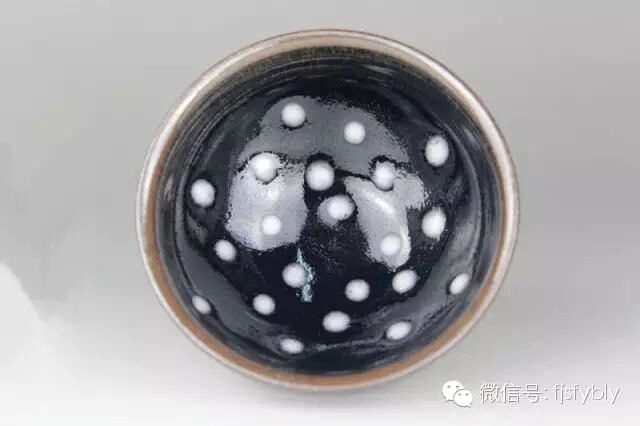
Jian ware illustrated in source material concerning Li Jinwang and the restoration of Jian Zhan.
Image source: Feiyiw.cn; original source watermark visible in image.
Quick Facts
栗金旺
September 1926
Qin County, Shanxi Province
Fujian Provincial Representative Inheritor
Jian Kiln and Jianzhan Firing Technique
建窑建盏烧制技艺
Nanping Xingchen Tenmoku Ceramics Research Institute
About Li Jinwang
Li Jinwang (栗金旺) was an important figure in the twentieth-century restoration,
research, and transmission of Jian ware. Born in 1926 in Qin County, Shanxi Province,
he later worked in the Jianyang region and became closely connected with the historic
Jian kiln tradition.
Around 1950, while working in Shuiji, Jianyang, Li Jinwang developed an interest in
the remains of the historic Jian kilns. He studied surviving kiln sites and Jian ware
fragments and gradually became deeply involved in efforts to understand and recover
techniques that had disappeared after the decline of the historic Jian kilns.
His work ultimately placed him among the early modern figures responsible for helping
return Jian Zhan from an archaeological and historical subject to a living ceramic tradition.
Role in the Modern Jian Zhan Revival
The recovery of Jian Zhan during the late twentieth century required far more than simply
copying the appearance of surviving Song Dynasty bowls. Researchers had to investigate
historic clay bodies, mineral glazes, kiln conditions, firing temperatures, glaze chemistry,
and excavated fragments from the original Jian kiln region.
Li Jinwang devoted many years to the recovery and study of these techniques. His work
combined archaeological observation, ceramic research, scientific testing, experimental
firing, and the organization of specialist research teams.
In 1991, he established the
Nanping Xingchen Tenmoku Ceramics Research Institute
(南平市星辰天目陶瓷研究所). There he worked with
Sun Jianxing (孙建兴)
and other researchers to investigate, reproduce, and further develop historic Jian ware.
Research & Study
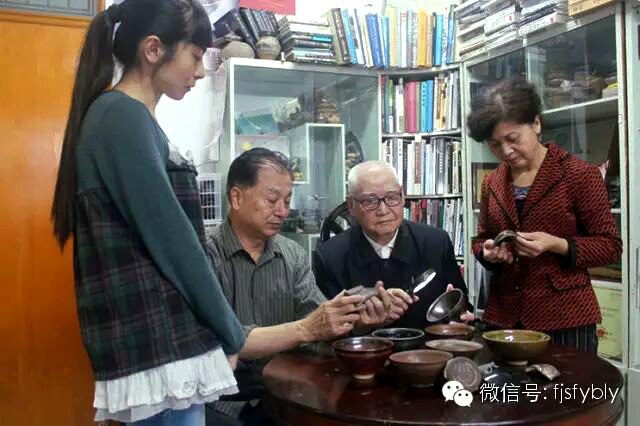
Archival Jian ware research image published with source material concerning Li Jinwang.
The individuals are not separately identified in the accompanying source.
Image source: Feiyiw.cn; original source watermark visible.
Li Jinwang’s contribution to Jian ware was strongly connected with research.
The Xingchen institute examined historical fragments, traditional materials,
glaze chemistry, and firing techniques in an effort to reconstruct Jian ware
effects that had disappeared for centuries.
Glaze & Firing Research
Research associated with Li Jinwang and the Xingchen Tenmoku Ceramics Research Institute
included the recovery and development of a wide range of Jian-style glaze effects.
Silver Hare’s Fur, Oil Spot, Leaf Pattern, and Iridescent Tenmoku products from the
institute were also subjected to scientific analysis and evaluation by the
Shanghai Institute of Ceramics of the Chinese Academy of Sciences.
Museum Collections
Several Jian ware research pieces associated with the Xingchen institute entered
the collection of the National Museum of China, including:
-
Reproduction Song Jian Kiln Hare’s Fur Tenmoku Bowl
仿宋建窑兔毫天目盏 -
Reproduction Song Jian Kiln Oil Spot Tenmoku Bowl
仿宋建窑油滴天目盏 -
Oil Spot Tenmoku Dragon and Tiger Tea Set
油滴天目龙虎茶具
Research & Recognition
Li Jinwang participated in international scientific conferences devoted to ancient
ceramics and contributed to published research on Jian ware.
-
Participated in the International Symposium on Ancient Ceramics Science and Technology
beginning in the 1990s. - Published research concerning iridescent Tenmoku glaze and large imperial Jian bowls.
- Co-authored scientific research concerning rare excavated Oil Spot Jian ware fragments.
-
In 1995, research on reproduction Song-style Tenmoku Jian ware received provincial
and municipal science and technology progress awards. -
Research into Yaobian was formally established as a Fujian provincial science
and technology project in 1997. -
A ceramic technology innovation project associated with the research program
received recognition at Fujian’s 1999 science and education achievements exhibition.
Family & Lineage
Li Jinwang’s influence continued through his family, creating one of the most important
modern Jian Zhan lineages.
Li Yun learned Jian ware production from her father and worked alongside her husband,
Sun Jianxing, during the restoration of Song-style Jian ware. Their daughter Sun Li
continued the family tradition, carrying the lineage into a third generation.
Legacy
Li Jinwang belongs to the foundational generation of the modern Jian Zhan revival.
His importance lies not only in ceramic production but also in research, organization,
preservation, and transmission.
Through the Xingchen Tenmoku Ceramics Research Institute and his family’s continued work,
archaeological knowledge and experimental ceramic science were transformed into a living
craft tradition. His daughter Li Yun, son-in-law Sun Jianxing, and granddaughter Sun Li
continued that work, forming a three-generation lineage closely connected with the
re-emergence of Jian Zhan in modern China.
Collector Notes
Li Jinwang’s name may appear less frequently in the modern retail Jian Zhan market than
later ceramic artists because much of his significance comes from restoration research,
institutional development, and transmission of the craft.
Collectors researching pieces connected with Li Jinwang should preserve original
certificates, boxes, institute markings, inscriptions, and any documentation connecting
the object with the Xingchen Tenmoku Ceramics Research Institute.
Name
His surname is written 栗.
His full Chinese name is 栗金旺,
romanized here as Li Jinwang.
Searching by the Chinese characters is especially helpful when researching his
work and historical records.
References
China Intangible Cultural Heritage Digital Museum
“一家三代人接力传承建盏技艺” — Three Generations Carry Forward the Jian Zhan Tradition
非遗网 · Feiyiw.cn
Profile of Li Jinwang (栗金旺) and his work restoring Jian Kiln/Jianzhan firing techniques
Journal of Ceramics / Jingdezhen Ceramic University
Research by Sun Jianxing and Li Jinwang concerning rare excavated Oil Spot Jian ware fragments
Nanping Federation of Returned Overseas Chinese
Historical account of the modern recovery and development of Jian Kiln and Jian Zhan