
Xiong Zhonggui · 熊忠贵
Fujian Provincial Representative Inheritor · Traditional Dragon-Kiln Wood-Fired Jian Ware
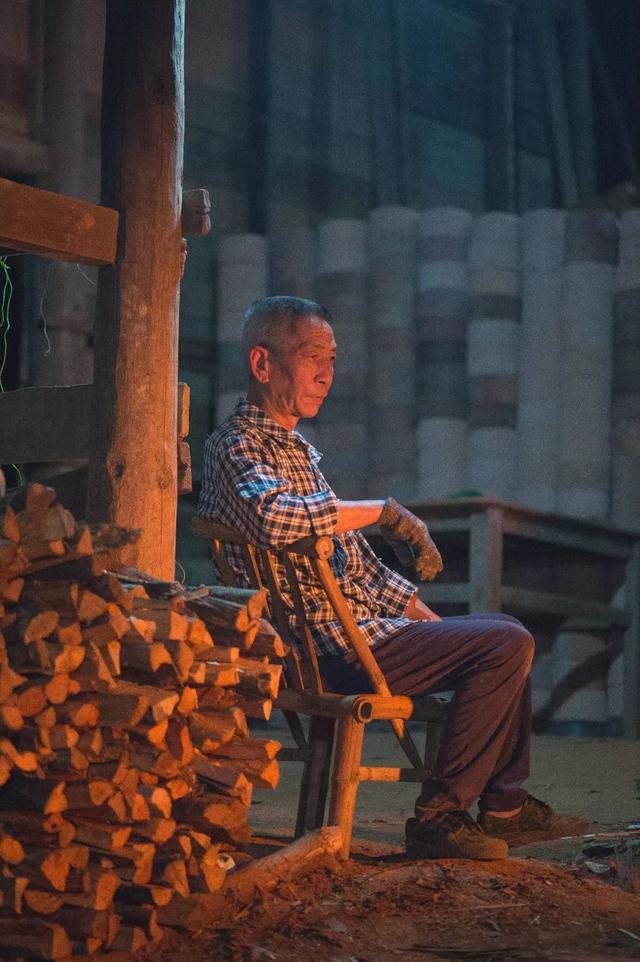
Image source:
Jiemian feature on Xiong Zhonggui and the old dragon kiln
.
Photographer not identified in the accessible source copy.
Quick Facts
熊忠贵
Xiong Zhonggui
August 1955
Shuiji Town, Jianyang, Fujian
Fujian Provincial Representative Inheritor
建窑建盏烧制技艺
Jian Kiln / Jian Ware Firing Technique
Jiyufang · 吉玉坊
Chief Craftsman / 总工艺师
Traditional dragon-kiln wood firing
宋工
Heritage Status · An Important Distinction
Xiong Zhonggui is an officially recognized
Fujian Provincial Representative Inheritor
of 建窑建盏烧制技艺, the traditional firing
technique of Jian kiln and Jian ware.
The Fujian Provincial Department of Culture formally included
熊忠贵, male, born 1955.08,
in its fourth group of provincial representative inheritors in
2018.
The technique itself is a
national-level intangible cultural heritage project,
project number VIII-188, entered in China’s third
national list in 2011.
These two levels should not be confused. Xiong is a
provincial-level representative inheritor of a nationally
listed heritage project. The national database identifies
Sun Jianxing (孙建兴) as the national-level representative inheritor
associated with the project.
Biography
Xiong Zhonggui was born in 1955 in Shuiji Town, the historic center
of Jian ware production in present-day Jianyang District. Accounts
from his workshop and multiple Chinese media profiles describe him
as coming from a family in which several generations worked with
ceramics.
His father is identified in biographical sources as
Xiong Xianbei (熊贤备). Xiong entered ceramic work
while still in his teens and learned pottery production and
traditional dragon-kiln firing from his father.
A detailed earlier account places him at the Shuiji pottery factory
in April 1970. It describes approximately twelve
years spent as a pottery craftsman, followed by several years in
which the old dragon kiln was used to fire refractory bricks as the
traditional pottery market declined.
This background is important to understanding Xiong’s later Jian
ware. Dragon-kiln firing was not adopted as a modern branding device
after he became known as a Jian ware artist. It was part of the
ceramic technology he learned at the beginning of his working life.
Early Jian Ware Research · A Chronology Question
Published accounts do not agree completely on the chronology of
Xiong Zhonggui’s early electric-kiln Jian ware experiments.
Jiyufang’s biography and a later heritage feature state that after
years of ceramic training, Xiong successfully produced black-glazed
Jian ware in an electric kiln in September 1980.
A detailed profile published in 2016 gives a different sequence.
It says that Xiong continued working with ceramics and refractory
materials before traveling to Yixing in 1988 to
purchase an electric kiln, after which he reportedly succeeded in
firing a hare’s-fur bowl within sixteen days.
A further profile dates the start of his systematic research into
recovering Song-style Jian ware firing to approximately
1992.
Because these accounts conflict, Fifty Shades of Clay preserves the
differing dates rather than selecting one version as definitively
established.
Teachers & Ceramic Lineage
Xiong’s principal and consistently documented teacher was his father,
Xiong Xianbei (熊贤备), from whom he learned pottery
and traditional kiln operation.
Secondary accounts differ regarding another ceramic master who
influenced his early development. A heritage feature published by
The Paper names Su Qinghe (苏清河), described
as a friend of Xiong’s father who provided instruction and guidance.
Other biographies instead name ceramic master
Su Tianhe (苏天和).
At present there is not enough primary documentation to determine
whether both men instructed Xiong or whether one name entered later
biographies incorrectly. The distinction is therefore retained here
rather than silently harmonized.
Jiyufang · 吉玉坊
In 2013, Xiong Zhonggui and an investor established
Jianyang Jiyufang Ceramics Co., Ltd.
(建阳吉玉坊陶业有限公司) using the historic kiln yard as
the center of production.
Jiyufang identifies Xiong as its 总工艺师,
meaning chief craftsman or chief technical artisan.
The company gives its location as the Yangmeishanping area of
Renshan, Shuiji Town, Jianyang District, Nanping, Fujian.
The workshop was established in the modern period, but the physical
kiln site is considerably older. Published descriptions place the
construction of the long dragon kiln around
1969–1970.
The Old Dragon Kiln
Xiong Zhonggui is particularly associated with the recovery and
continued use of a traditional hillside dragon kiln at the Jiyufang
kiln yard.
Contemporary reports describe the kiln as approximately
36 meters long, built from earth and brick along the
slope. It is divided into the head, kiln body, tail and chimney, with
numerous side openings used for adding wood during the firing.
Rather than constructing a new decorative “traditional kiln” for the
modern Jian ware market, the 2013 Jiyufang project centered on
returning an older working ceramic kiln to intensive Jian ware
production.
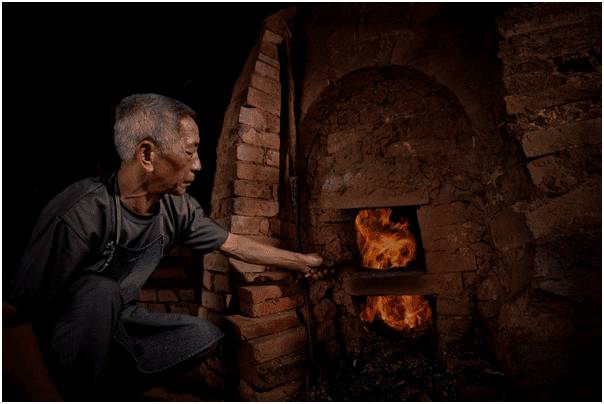
Image source:
隐庐器 / Wuyi Jianzhan, Xiong Zhonggui artist archive
.
Reproduced here for educational documentation of his firing practice.
Dragon-Kiln Firing
Reports describing Xiong’s traditional firing practice place peak
temperatures around 1,300°C. A large kiln load may
contain approximately 4,000–5,000 unfired bowls.
One detailed heritage report states that a firing of this size might
produce only around 200 usable finished pieces.
China News Fujian separately quoted Xiong describing the overall
success rate of his dragon-kiln firing as only about
7 percent.
The entire cycle includes preparing and loading the kiln, firing,
cooling and finally opening the kiln. Depending on how the process is
counted, reports describe the complete cycle as lasting more than
half a month, while the active firing itself requires days of
continual attention.
Wood is fed through multiple openings along the kiln body as the
firing progresses. Temperature, flame direction, atmosphere, wood
condition, bowl placement and even changing weather can affect the
final result.
When Xiong returned the old dragon kiln to serious Jian ware
production in 2013, the results were punishing. Multiple reports state
that he completed seven successive kiln firings
without producing a piece he regarded as satisfactory.
In April 2014, the eighth firing finally yielded a
little over a dozen hare’s-fur bowls described as having the subdued,
lustrous surface he had been seeking.
Contemporary accounts report that total expenditure by that point had
exceeded RMB 2 million. The monetary figure is a
reported estimate rather than an independently audited cost.
Clay, Glaze & Traditional Materials
Xiong’s work is closely associated with the traditional material
vocabulary of the Jianyang region.
Published accounts describe the use of local iron-rich clay together
with local red glaze mineral and 草木灰, plant or wood
ash, in preparation of the glaze.
Earlier reports describe clay being collected from the area surrounding
the kiln yard itself. Xiong’s approach emphasizes local raw materials,
hand forming, single application of glaze and wood firing rather than
attempting to make every bowl emerge with an identical surface.
Documented Work Examples
The following examples are cataloged under Xiong Zhonggui’s name by
隐庐器 / Wuyi Jianzhan and carry visible XZG catalog numbers.
They are included as useful collector-reference examples rather than
as a complete survey of his output.
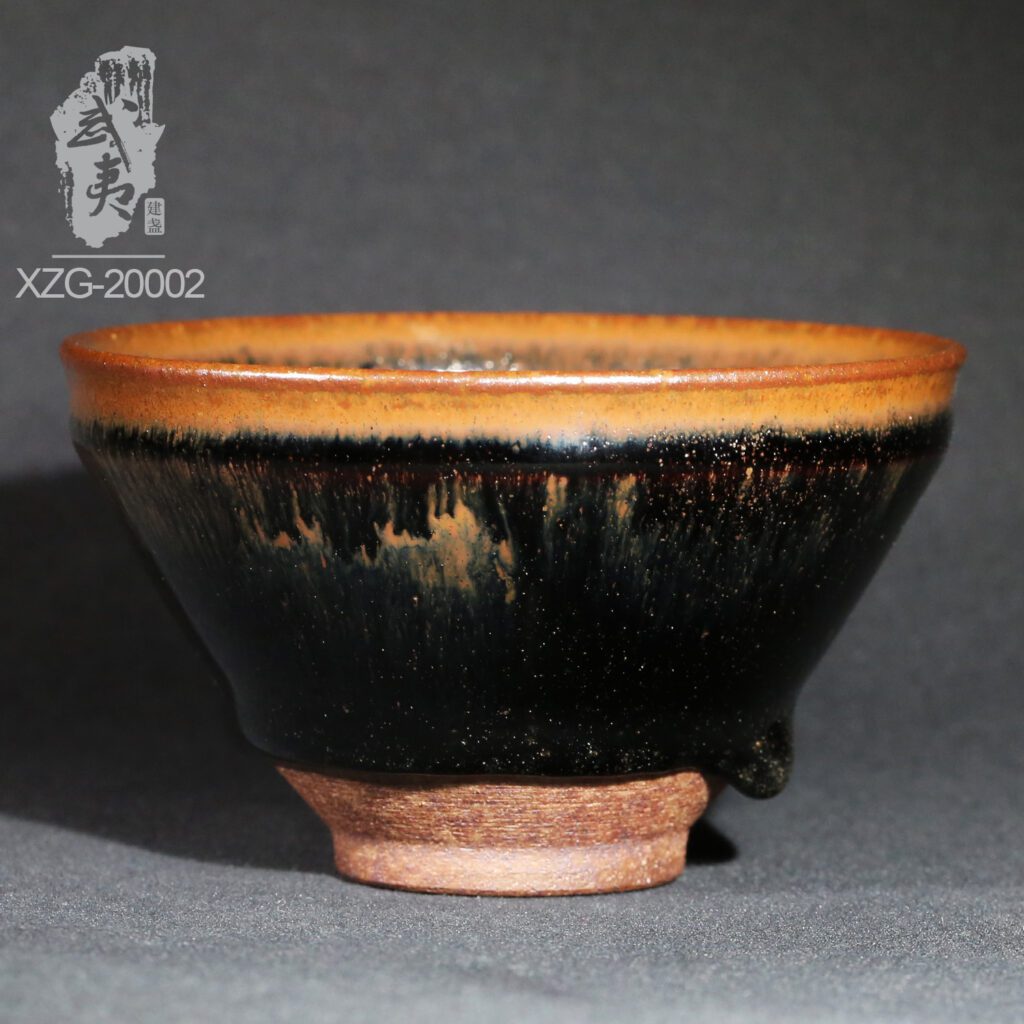
A documented Xiong Zhonggui Jian ware example showing a dark
iron-rich glaze, warm rim and naturally developed firing effects.
Image source:
隐庐器 / Wuyi Jianzhan
.
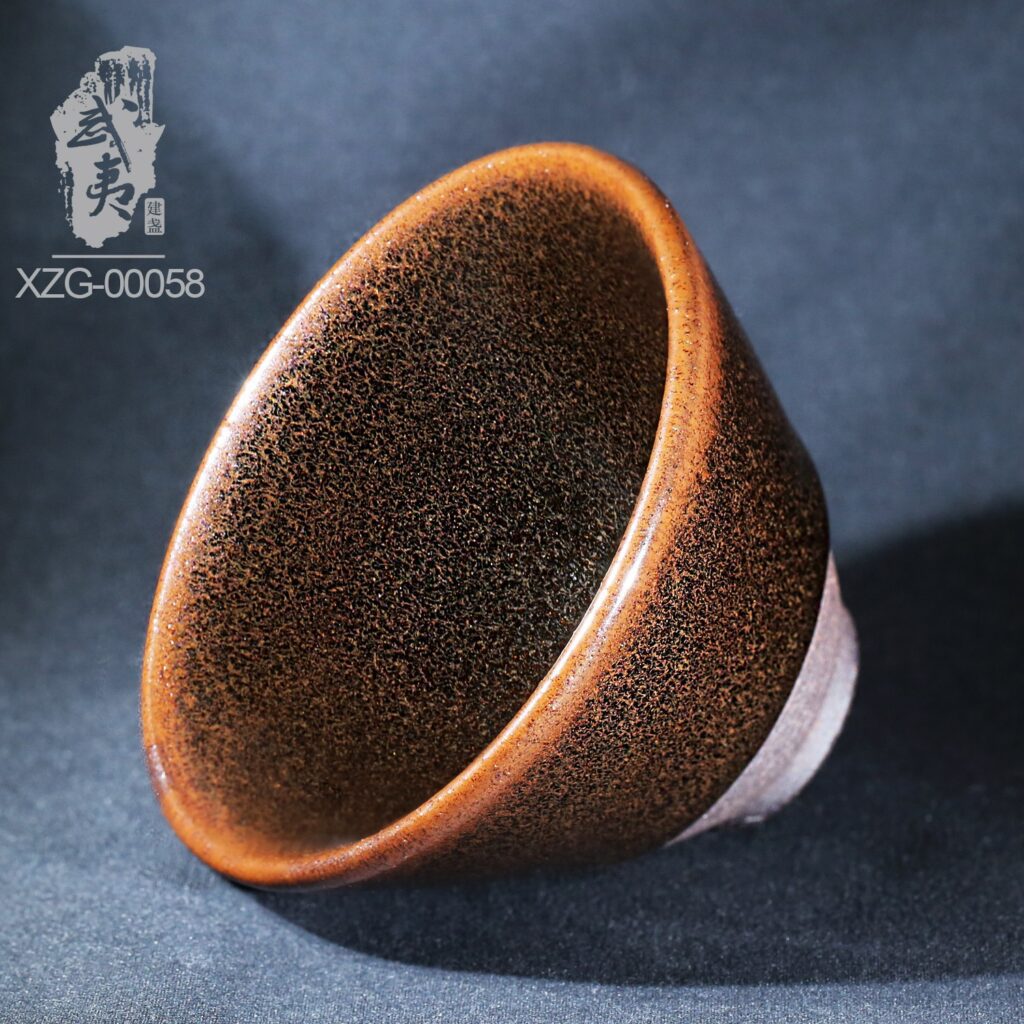
Cataloged as a wood-fired douli-style bowl, with a restrained,
finely mottled brown-black surface characteristic of Xiong’s
traditionalist approach.
Image source:
隐庐器 / Wuyi Jianzhan
.
Glazes & Forms
Xiong Zhonggui is associated with a broad range of dark, iron-rich
Jian ware surfaces, but his work is particularly identified with
traditional effects arising naturally from kiln temperature and
atmosphere.
Wujin / black-gold glaze
Hare’s fur
Silver hare’s fur
Partridge-feather / spotted effects
Brown / sauce-brown glaze
Iron-rust spot
Purple-jade type effects
Douli / conical bowl form
Profiles of Xiong repeatedly emphasize a comparatively restrained
aesthetic: dark ground colors, spontaneous crystallization and kiln
variation, with an emphasis on the visual character of historic Jian
ware rather than highly controlled decorative effects.
Marks · 宋工
Earlier reports on Xiong Zhonggui and Jiyufang identify
宋工 as an important workshop mark.
Sources state that Jiyufang registered the 宋工 identification when
the modern workshop was established in 2013. Earlier Xiong/Jiyufang
pieces may therefore be encountered carrying this mark.
For authentication purposes, however, a 宋工 mark should be treated
primarily as evidence of association with the Jiyufang workshop.
It should not, by itself, be taken as proof that every marked piece
was individually thrown or fired personally by Xiong Zhonggui.
2008 Ceramic Exchange with Japan
Multiple sources, including Jiyufang’s own archived material, document
contact between Xiong Zhonggui and Japanese ceramic artist
Lin Gongzhu / 林恭助.
Jiyufang states that Lin traveled to Shuiji in
2008 to visit Xiong and discuss dragon-kiln Jian
ware. Later workshop archives preserve photographs and references to
further ceramic exchange involving Lin and the Jiyufang kiln site.
The documented 2008 visit is included here without repeating broader
promotional claims that are more difficult to verify independently.
Heritage Recognition
Reported as one of Jianyang’s first representative inheritors for
the Jian kiln/Jian ware firing technique.
Reported as a Nanping municipal representative inheritor.
Officially named in Fujian Province’s fourth group of
representative intangible-cultural-heritage inheritors.
Xiong continues to appear in Fujian’s provincial heritage
documentation as an inheritor of 建窑建盏烧制技艺.
Selected Awards & Professional Honors
Chinese media profiles record numerous awards for Xiong’s Jian ware.
Selected documented examples include:
-
供御兔毫盏 — gold award at the 2015 China
Arts & Crafts Fine Works exhibition associated with the
Hefei International Cultural Expo. -
黄兔毫深腹大撇口盏 — arts and crafts gold
award, Beijing, 2015. -
黄兔毫深斗束口盏 — silver award in the
2017 Baihua Cup Chinese Arts & Crafts Fine Works competition. -
黄兔毫束口深斗盏 — silver award in the
2018 Fujian Arts & Crafts Creative Design Competition. - 酱紫色斗笠盏 — 2020 Guojiang Cup gold award.
-
树皮纹斗笠盏 — 2021 Golden Phoenix
Innovative Product Design gold award.
Since 2017, profiles also record titles including
Fujian Ceramic Art Master,
Nanping Arts and Crafts Distinguished Artist,
and Fujian Arts and Crafts Notable Artist.
These artistic and professional awards are separate from Xiong’s
government-recognized intangible-cultural-heritage status.
Institutional Collections
Published biographies report works by Xiong Zhonggui entering
institutional collections including the Xiamen Museum, Nanping Museum,
Jianyang Museum and Shanghai Institute of Visual Arts.
Not every reported acquisition has yet been independently matched to
an online institutional catalog record, so these collection claims are
retained as published biographical information rather than described
as universally independently verified.
Students & Transmission
Xiong’s role as an inheritor extends beyond production to the
transmission of Jian ware skills.
A 2019 issue of the China Art Newspaper, published
by the China Federation of Literary and Art Circles, explicitly
describes Li Jiafang (李加方) as Xiong Zhonggui’s
disciple during an artists’ visit to Jiyufang.
Collector and marketplace records from different periods also
identify contemporary Jian ware maker
Pan Jiacai (潘家财) as a disciple of Xiong.
That relationship currently has good secondary-source support but
has not yet been located in an official biography issued by Xiong or
a government heritage body.
Why Xiong Zhonggui Matters
Xiong occupies a somewhat different place in the modern Jian ware
revival from figures whose principal contribution was laboratory
reconstruction of historic glaze recipes.
The national restoration project begun in the late 1970s brought
together research institutions and ceramic specialists and achieved
successful reconstructed Jian ware in the early 1980s.
Xiong’s importance lies particularly in the
continuity of practical kiln knowledge: a ceramic
worker raised within Shuiji’s pottery tradition who later returned
to a long hillside kiln and devoted himself to recovering difficult,
low-yield wood-fired Jian ware production.
His story links ordinary regional pottery, an old working dragon kiln,
the modern Jian ware revival and today’s formally recognized heritage
system. That continuity is perhaps the clearest way to understand his
place within contemporary Jian ware.
Research Notes
Some published biographies use dramatic phrases such as
“restoring an 800-year-lost technique” or describe Xiong as a
“national-level inheritor.” These statements require context.
Jian ware restoration was a wider modern effort involving numerous
researchers and makers. Xiong’s individual government rank is
provincial, although the heritage project itself is national-level.
Sources also conflict on the exact dates of his earliest electric-kiln
Jian ware experiments and on whether Su Qinghe or Su Tianhe provided
supplementary instruction.
These disagreements have been preserved in this profile so that
collector-facing biography can be distinguished from independently
documented government records.
Sources & Further Reading
Fujian Provincial Department of Culture and Tourism
Official fourth group of Fujian provincial representative
intangible-cultural-heritage inheritors, including 熊忠贵.
View official record
China Intangible Cultural Heritage Network
National heritage record for 建窑建盏烧制技艺, project VIII-188.
View national project record
Jianyang Jiyufang Ceramics · 吉玉坊
Workshop biography, kiln information and Xiong Zhonggui profile.
Jiyufang master biography
The Paper · 澎湃新闻
Heritage feature documenting Xiong’s background, traditional materials,
dragon kiln, firing process and works. Photographs in the article are
credited to Chen Qihui (陈琦辉).
Read the feature
China News Fujian · 中新网福建
“熊忠贵:浴火重塑千年建盏神韵,” including firing statistics,
awards and photographs credited to Chen Qihui.
Read the article
Fujian Daily / Minbei Daily · 福建日报 / 闽北日报
Report on traditional dragon-kiln firing, the unsuccessful 2013
firings and the April 2014 breakthrough.
Read the report
Sina Collection / Artron historical profile
Earlier biography containing the alternative 1988 electric-kiln
chronology.
Read the historical profile
China Art Newspaper · 中国艺术报
2019 report explicitly referring to Li Jiafang (李加方) as Xiong
Zhonggui’s disciple.
View publication
隐庐器 / Wuyi Jianzhan
Collector-facing catalog of documented Xiong Zhonggui works,
including XZG-20002 and XZG-00058.
View Xiong Zhonggui catalog
Image documentation:
Third-party photographs reproduced on this page remain the property
of their respective photographers or source publishers. They are
presented in limited web resolution for educational, historical and
collector-identification purposes, with source attribution and links
to the originating publications where known. Fifty Shades of Clay
does not claim ownership of these images.