
Fifty Shades of Clay • Collector Research
Yixing Zisha: What Does “Handmade” Really Mean?
全手工 · 半手工 · 手拉坯 · 灌浆
Cheap purple-clay teapots are often dismissed as automatically machine-made.
At the same time, sellers may insist that even very inexpensive pots are “handmade.”
Both statements can be misleading. The better question is: how was the pot actually formed?
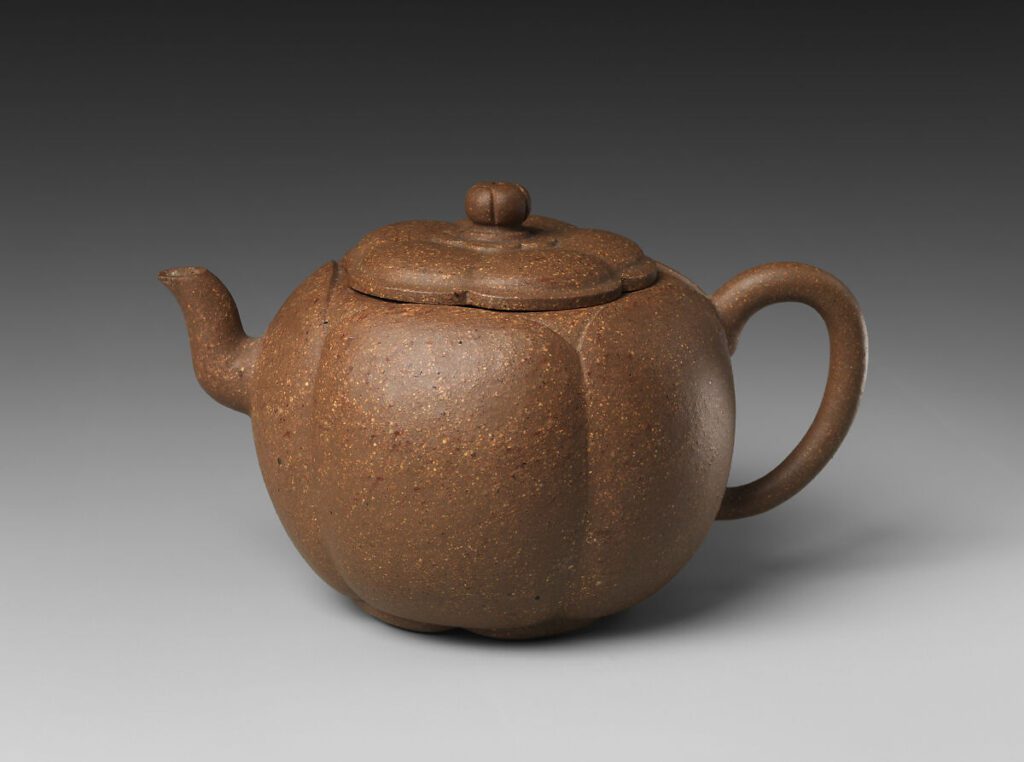
Stoneware, Yixing ware. The Metropolitan Museum of Art, Public Domain.
🫖 The Short Answer
Yes, a cheap teapot can involve a great deal of hand work.
But that does not make every hand-touched, mold-assisted, or wheel-formed pot a traditional Yixing zisha teapot.
But “handmade” is not the same claim as 全手工
(quán shǒugōng, fully handmade), and a pot being sold as “zisha”
is not automatically the same thing as a teapot made according to the
traditional Yixing zisha craft.
Traditional Yixing zisha teapot making is a specific forming tradition based on
preparing clay pieces or slabs, beating and shaping the body, joining components,
and refining the vessel by hand. Modern Yixing commerce also contains wheel-thrown,
slip-cast, machine-assisted, and other production methods.
Those things can all exist in the same marketplace without being the same craft category.
China’s official intangible-cultural-heritage description of
宜兴紫砂陶制作技艺 describes the craft using Yixing zisha clay
with a distinctive granular and dual-pore structure, then lists processes such as
打泥片 (preparing/beating clay slabs),
拍打身筒 (beating or paddling the body for round forms), and
镶接身筒 (joining the body for square forms).[1]
China’s current national zisha standard, GB/T 10816-2024, also specifically
limits teapot products within that standard to hand beating/joining and
inlay-forming techniques.[7]
At the same time, a 2022 Yixing government discussion of the actual commercial
market explicitly lists 全手工, 半手工(模型), 手拉坯 and 灌浆,
and says that traditional hand methods coexist with wheel forming, slip casting,
3D printing, and other modern forming technologies.[2]
So when two knowledgeable people seem to give different answers about whether
something is “zisha,” they may actually be answering two different questions:
- What products exist in the modern Yixing/zisha marketplace?
- What counts as the traditional Yixing zisha teapot-making craft in the stricter sense?
Jenny,
one of the live hosts already featured on Fifty Shades of Clay, reviewed our original page and caught an
important problem in the way we had organized the forming methods. Jenny is from the area and has formal
tea training. She explained that fully handmade and half-handmade Yixing zisha belong to the traditional
slab-beaten and body-building tradition, while wheel-thrown and slip-cast production should not have been
presented beside them as equivalent traditional methods. She also asked us to be more careful about the
material itself, not just the way a pot is shaped.
We went back through the Chinese craft descriptions, standards, government material, and published research.
The main correction Jenny made is now built into this page rather than separated out as an opinion box.
[J]
🪨 First: What Does “Purple Clay” Mean?
紫砂 (zǐshā) is commonly translated into English as
“purple clay” or “purple sand.” Jenny specifically asked us to make one thing clearer here: in this context,
we are talking about the specific zisha material and tradition associated with Yixing, not simply
any clay that happens to look purple. She suggested “the purple clay” in English to emphasize that specificity.
To keep the English natural while preserving her point, this page uses zisha whenever the specific
material/tradition is what we mean.[J]
The name should not be read as a literal color test. Genuine historic and modern Yixing zisha bodies can fire in a range
of reddish, brown, purple-brown, yellowish, greyish, and other tones depending
on mineral composition, clay recipe, processing, and firing.
Traditional clay names include 紫泥 (zini),
红泥 (hongni), 朱泥 (zhuni), and
本山绿泥 (benshan lüni), among many others. Historic writing
also uses the idea of 五色土 (wusetu), “five-colored clay,”
to describe the unusually broad palette associated with Yixing materials.
A 2025 archaeological materials study examined 187 excavated zisha sherds from
the Shushan kiln site and documented changes in clay recipes, particle size,
iron content, and fired color from the Ming period through the Republican era.
The study reinforces something collectors should keep in mind: there has never
been one single fixed “zisha recipe” or one authentic surface color.[8]
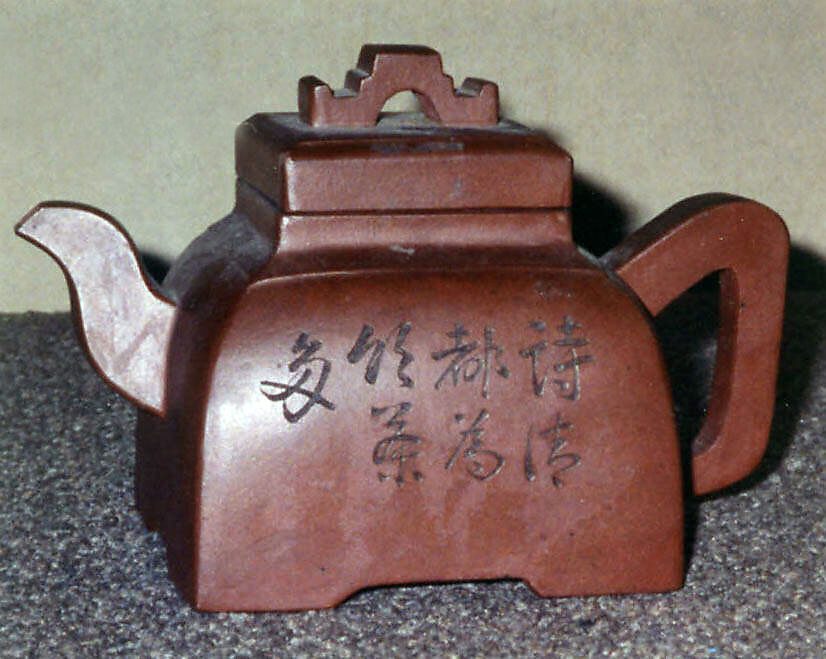
The Metropolitan Museum of Art, Public Domain.
forming technique and raw material.
They are separate questions. A beautifully hand-built pot can use questionable
material, while a pot made from clay sold as zisha can be formed by a modern
production method.
Color does not prove provenance
A purple-brown teapot is not authenticated as Yixing zisha simply because of
its color. Surface texture, “sandiness,” sparkle, pores, firing marks, and seller
terminology can all be useful context, but none of them independently proves
where the raw material came from.
Why the clay itself matters
Jenny also pointed out that this is not only a question of technique. Traditional zisha is a distinctive
mineral clay body with a visibly granular character, and it does not behave exactly like the smooth, highly
plastic pottery clays many Western collectors picture when they hear “hand-thrown.” In her training and
experience, conventional wheel-thrown production is a warning sign because the material and preparation used
for that process may not be the same as the traditional zisha body collectors are seeking.
[J]
That caution is important, especially because a finished teapot cannot tell us its geological origin merely by
showing wheel marks. Public Yixing material sometimes uses 手拉坯 when discussing products in the broader
zisha marketplace, so FSOC does not use the wheel by itself as a laboratory test for clay provenance. Instead,
we treat a wheel-thrown claim as a reason to ask a second question: what material was actually used?
[2]
that “hand-thrown” means traditional Yixing zisha. Ask about both the forming method and the clay.
🏺 Traditional Yixing Zisha Is a Specific Craft Tradition
Yixing Zisha Pottery Making Technique
(宜兴紫砂陶制作技艺) was included in China’s first national list
of representative intangible cultural heritage projects in 2006.
The official description places the craft in Yixing, Jiangsu, and defines it
through local material, specialist tools, and specific hand-forming processes.[1]
This matters because “traditional Yixing zisha” is more specific than
“a teapot made from purple-colored clay,” and more specific than
“a teapot made by a person.”
The traditional body-building system centers on prepared clay pieces or slabs.
Round bodies are beaten and paddled into form; square or angular bodies are
joined from prepared pieces. Spouts, handles, lids, feet, and other parts are
made and fitted separately, followed by extensive refinement.
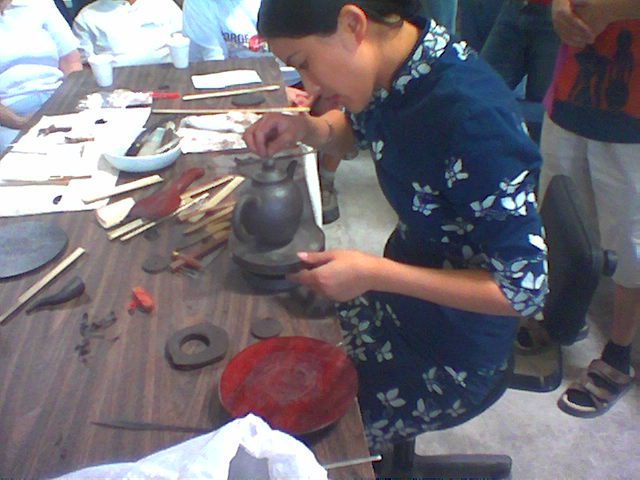
Photo by Quinn Norton, 2004, CC BY 2.0.
The useful question is what role did the hands, tools, molds, wheel, or machine play in forming the body?
🛠️ Traditional Yixing Zisha Forming
全手工 — Quán Shǒugōng
Fully Handmade / Fully Hand-Built
In collector and workshop language, 全手工 refers to a pot whose body is built
and established through traditional hand-forming rather than being given its
main shape by a body-forming plaster mold.
“Fully handmade” does not mean the artisan works with bare fingers and nothing
else. Traditional Yixing potters use a large specialist tool kit, templates,
turntables, paddles, scrapers, ribs, cutting tools, gauges, and other aids.
The distinction is about how the vessel body is formed.
Modern ethnographic research in Yixing describes hand-built production using
slab construction, paddle shaping, separately made components, and extensive
manual refinement.[4]
半手工 — Bàn Shǒugōng
Half-Handmade / Mold-Assisted Handwork
Half-handmade is not the same thing as slip casting.
In typical mold-assisted zisha production, clay is still prepared and worked
as a plastic body. A plaster mold assists in controlling or refining the shape.
The vessel is then removed, joined, fitted, and finished by hand.
The amount of manual skill involved can be substantial. Chinese Arts and Crafts
Master Xu Xiutang 徐秀棠 specifically warned against treating
“handmade” and “mold-made” as a simple quality boundary. He wrote that using a
mold does not automatically mean something is no longer handmade. The important
question is how the mold is being used.[3]
A mold used as a tool to help an artist realize a design is not the same production
situation as a mold used to standardize dimensions, increase output, or compensate
for limited forming skill.
半手工 generally works with a plastic clay body that is manually prepared and
then assisted by a mold. 灌浆 begins with a fluid clay mixture that forms
against the wall of a porous mold. They are different processes.
⚙️ Other Methods Found in the Modern Zisha Market
This is the most important correction Jenny made to our original page.
We had placed slip casting beside 全手工 and 半手工 as though all three were
equivalent principal methods of traditional Yixing zisha teaware. They are not.
[J]
Yixing government material confirms that wheel forming, slip casting, machine
forming, and other modern methods are very much part of the modern commercial
landscape. But the official intangible-cultural-heritage description and current
product standards define traditional Yixing zisha teapot construction much more
narrowly.[1][2][7]
手拉坯 — Shǒu Lā Pī
Wheel-Thrown / Wheel-Formed
Here the vessel body is formed on a rotating pottery wheel.
The maker is using their hands, so the English phrase “hand-thrown” is not
necessarily dishonest by itself.
However, wheel throwing is fundamentally different from the Yixing tradition
of beating clay slabs, paddling a body, and joining prepared components.
For FSOC, “hand-thrown” should never be treated as a translation of 全手工.
Jenny’s warning goes one step further: when a pot is marketed as “hand-thrown zisha,”
she questions not only the forming method but also whether the clay body is the traditional material collectors
expect. FSOC therefore treats wheel-thrown listings as something that needs clarification rather than accepting
“zisha” from the sales title alone.[J]
method described on this page. It should also prompt a clay question: what material was prepared for
wheel throwing, and where did it come from?
灌浆 — Guàn Jiāng
Slip Casting
Slip casting starts with a fluid clay mixture. The slip is introduced into a
porous mold, the mold draws water from it, and a clay wall forms against the
mold surface. Excess material is removed, and the piece is later released,
trimmed, assembled, and finished.
Human work may still be involved in trimming seams, attaching parts, fitting lids,
surface finishing, decoration, and firing. That is why “hand-finished” can be true
without the body being traditionally hand-built.
But slip casting is not the hand-beaten and joined forming method
described in the recognized Yixing zisha craft tradition or the current national
teapot standard. Jenny also cautioned that the material preparation used for slip casting can be a problem for
collectors seeking the texture, use characteristics, and long-term “seasoning” experience associated with
traditional zisha. For that reason, she does not recommend slip-cast ware as a substitute for traditional Yixing
zisha teapots.[J]
机车壶
Machine-Assisted Forming
Collectors also encounter the market term 机车壶, usually referring broadly to
machine-assisted forming. The exact equipment and sequence can vary, so the term
should not be treated as one perfectly standardized technical process.
The safest approach is to ask what equipment actually formed the body rather than
assuming that every seller uses 机车 in exactly the same way.
Swipe to see more →
Fully handmade
Traditional hand-built body. Clay slabs/pieces are beaten, joined, paddled, assembled, and refined by hand.
Mold-assisted handwork
Traditional-style clay body with mold assistance during forming. Not the same process as slip casting.
Wheel-thrown
Body formed on a rotating wheel. Jenny does not classify this as a true traditional Yixing zisha teapot.
Slip cast
Fluid clay body forms against a porous mold. A modern production method, not traditional slab-beaten construction.
Machine-assisted
Mechanical equipment establishes or assists the form. Ask what process and material were actually used.
What does this mean for collectors?
Jenny’s recommendation is straightforward: if the goal is the traditional Yixing zisha using and collecting
experience, she would not choose slip-cast or wheel-thrown ware. In the strict sense she is using, those pieces
are outside the traditional Yixing zisha teapot category.[J]
That does not require us to pretend such objects do not exist in the modern marketplace. It means we should name
them accurately. A wheel-thrown pot should be described as wheel-thrown. A slip-cast pot should be described as
slip-cast. Neither should be allowed to borrow the prestige of 全手工 simply because a seller uses the English word
“handmade.”
The clearest problem is misrepresentation: a cheaper or different process presented as 全手工,
as a famous artist’s personal work, as rare original Yixing ore without evidence, or simply as something it is not.
🤔 Why Do Chinese Sources Sometimes Sound Like They Contradict Each Other?
Because “zisha” can be used at different levels of specificity.
A government discussion about the online industry may use 紫砂壶 broadly enough
to describe all of the production methods currently sold through that market.
That is exactly what the Yixing government did in 2022 when it listed full-hand,
half-hand, wheel-formed, and slip-cast production together and then separately
described traditional and modern forming technologies.[2]
A cultural-heritage description or geographical-indication standard is answering
a narrower question: what defines the protected or traditional Yixing zisha craft?
Those documents focus on local Yixing material and the traditional hand beating,
joining, and inlay-forming system.[1][10]
When the context disappears in translation, English-speaking collectors can end
up with two statements that appear impossible to reconcile:
- “Yixing sells wheel-thrown and slip-cast zisha teapots.”
- “Traditional Yixing zisha teapots are not wheel-thrown or slip-cast.”
Both can describe different layers of the same modern industry.
🔬 What Researchers Actually Saw in Modern Yixing
A particularly useful peer-reviewed ethnographic study by
Xuyang Gao, Anke Hein, and Patrick Quinn examined contemporary
zisha production through fieldwork in Yixing.[4]
Their research identified two broad production systems.
Hand-Built Collector Production
The researchers documented small-scale household or studio production using
manual slab building, paddle shaping, individually made components, careful
clay preparation, and comparatively low output. These wares were associated
with the higher-value collector market.
Mold-Based Daily Ware
They also observed inexpensive daily ware made with plaster molds, standardized
forms, greater use of labor-saving machinery, and much higher production output.
The divide was not perfectly rigid. Workshops and makers can combine old and new
technologies, and an artisan known for hand building may also use mold-assisted
or machine-processed production in some circumstances.
The researchers also emphasized how difficult undisclosed mold assistance can be
for an ordinary consumer to detect after a pot is finished.
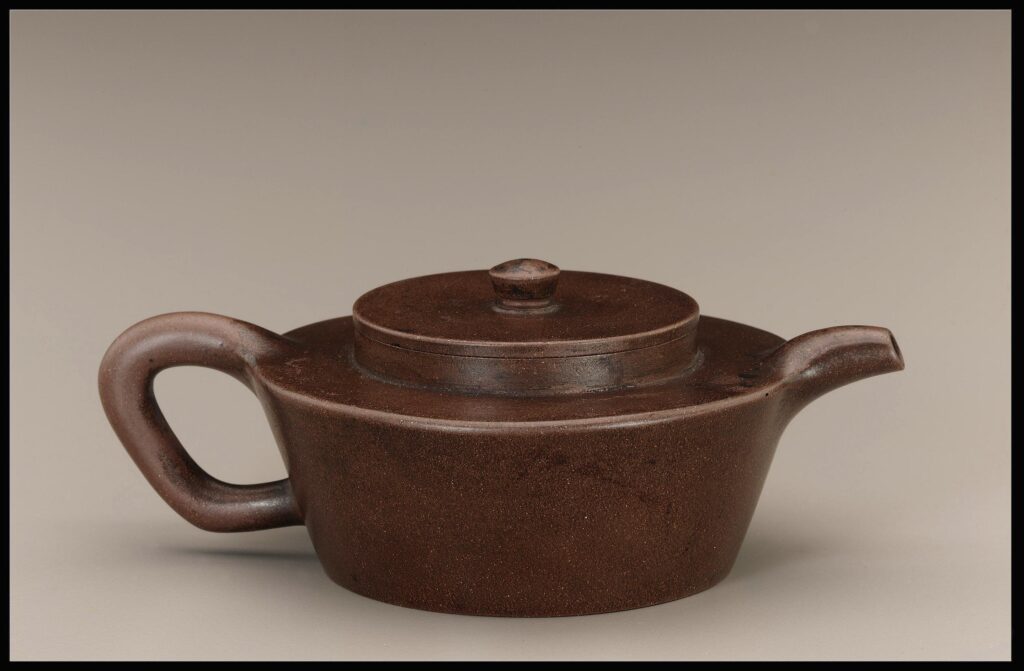
National Museum of Asian Art, Smithsonian Institution.
Their fieldwork also found that the cheaper molded production stream often used
more widely available iron-rich clays rather than the rarer local materials used
by the hand-builders they observed. That does not mean every molded teapot uses
the same material. It does show why forming method and clay provenance
must be investigated separately.
💵 So… Can a Fully Handmade Zisha Pot Really Cost $20?
Our answer is still:
We cannot responsibly create a universal dollar amount below which 全手工 becomes
physically impossible. Simple repeated utility forms can be made far faster than
elaborate collector pieces, and an expert who has made the same shape hundreds of
times can work at a speed that surprises modern collectors.
But a normal retail price around US$20 is also completely compatible with the
economics documented for mold-based daily ware in Yixing.
Evidence #1: Molded pots really can be extremely cheap
The Gao, Hein, and Quinn field study recorded mold-made teapots in a very broad
low-cost retail range and observed factory-style production exceeding 30 teapots
per day in some settings.[4]
So an extremely inexpensive teapot does not require an imaginary fully automated
factory to make economic sense. Mold assistance, division of labor, standardized
forms, cheaper material, and high output can drive the price down dramatically
while people still perform much of the work.
Evidence #2: “Handmade takes several days” is not a universal rule
Historical testimony from master Xu Hantang 徐汉棠 gives us a rare
production-speed comparison from the 1950s.[5]
Xu recalled that when he began producing the relatively simple qieduan
form in 1955, he initially made about three pots per day. As he became more
practiced, he eventually reached roughly nine to ten per day.
In 1956 he began making the more difficult small shuiping 水平
pot and produced roughly six or seven per day. After learning how to make plaster
molds and secretly using one to assist the body, he reported increasing output to
about sixteen per day.
Swipe to see more →
His output while still learning the repeated form.
The same type became much faster with repetition and experience.
A more difficult small form, still produced several times in a working day.
His recollection shows how dramatically mold assistance could increase output.
This is why we do not repeat statements such as “a genuine fully handmade pot
must take three to five days” as a universal fact.
Complexity, size, form, maker skill, repetition, workshop organization, and the
amount of refinement can change production time enormously.
Evidence #3: Modern collector-oriented hand building can also be much slower
The craftspeople observed in the 2023 ethnographic study often worked in a very
different production environment from Xu Hantang’s 1950s utility production.
Their process involved elaborate clay preparation, multiple separately prepared
pieces, individually designed forms, and much lower output.[4]
The apparent contradiction teaches us something useful:
there is no single “handmade production speed.”
What does price actually tell us?
Price is a plausibility clue, not an authentication test.
Swipe to see more →
Plausible. Human handwork may be involved without the pot being 全手工.
Verify it. Low price is not proof of fraud, but the specific claim deserves evidence.
More claims to verify. Ask separately about construction and clay provenance.
Very strong claim. Documentation matters far more than sales wording.
Still not proof. Price can support plausibility, not authenticate a pot.
🚩 False “Fully Handmade” Advertising Is a Real Problem
Concern about misleading zisha marketing is not simply collector paranoia.
Yixing government material has specifically discussed the difficulty consumers
have distinguishing different forming methods after firing and the resulting
opportunity for cheaper production to be sold as something more expensive.[2]
In one enforcement case, a seller advertised a zisha product with the wording
“成型工艺:全手工拍打”, meaning “forming technique: fully handmade
beating.” Authorities later determined that the product was actually
half-handmade. On March 6, 2025, the Yixing market regulator imposed a
10,000 RMB fine.[6]
the claim. It does not independently prove how the pot was formed.
🔎 Can You Identify 全手工 Just by Looking?
Sometimes construction evidence can support an attribution.
It should rarely be treated as proof by itself.
Be careful with internet rules such as:
- “Look for a seam.”
- “An interior stamp proves it.”
- “Uneven walls mean handmade.”
- “Perfect symmetry means machine-made.”
- “Tool marks prove the named artist personally made it.”
Construction traces can be refined away, deliberately retained, added, altered,
or imitated. Mold-assisted pots can receive extensive hand finishing.
A highly skilled fully handmade pot can also be extremely clean and symmetrical.
The 2023 Yixing field research specifically notes that when plaster-mold assistance
is not disclosed, non-expert consumers may have great difficulty distinguishing
the difference from the finished pot alone.[4]
Authentication is therefore cumulative:
construction evidence + seller disclosure + maker provenance + clay claim +
price plausibility + documentation + known production context.
💬 Better Questions to Ask a Seller
Asking only “Is it handmade?” gives a seller far too much room to answer
according to their own definition.
Swipe to see more →
Is the body fully hand-built/beaten, or is a plaster mold used to assist forming?
Was a plaster mold used to establish or refine the body shape?
Was the body traditionally beaten, wheel-thrown, slip-cast, machine-assisted, or formed another way?
Was this pot personally made by the named artist or by a workshop worker?
Where did the clay come from? Can the clay source be identified specifically?
Can I see the body-forming process for this model?
✅ Collector Checklist for a Very Cheap “Fully Handmade” Pot
-
Read the exact wording.
“Handmade,” “hand-finished,” “hand-thrown,” and 全手工 are not interchangeable. -
Separate clay from construction.
“Original clay” does not prove full-hand construction, and traditional
construction does not independently prove the clay source. -
Ask about molds directly.
半手工 mold assistance and 灌浆 slip casting are not the same process. -
Ask how the body itself was formed.
Was it beaten and joined, wheel-thrown, slip-cast, machine-assisted, or something else? -
Look at production volume.
Large quantities of nearly identical pieces are useful context, although
uniformity by itself is not proof. -
Treat certificates as supporting evidence.
A certificate is only as trustworthy as its issuer and its connection to the actual pot. -
Use price as context, not authentication.
Cheap does not automatically mean fake. Expensive does not automatically mean genuine.
📜 The Current Standards, and Why They Matter
GB/T 10816-2024 《紫砂陶器》
China’s current national zisha-ware standard was published on December 31, 2024
and came into effect on July 1, 2025, replacing GB/T 10816-2008.
It is a recommended national standard rather than a law declaring every object
outside it illegal.
What matters for this page is the wording highlighted by Yixing’s municipal
government when the new standard took effect: teapot products are
specifically required to use hand beating/joining and inlay-forming techniques.[7]
That gives us a much firmer technical basis for separating traditional zisha
teapot construction from wheel-thrown and slip-cast production than our original
page had.
DB32/T 4639.1-2024
Geographical Indication Product: Yixing Zisha, Part 1: Tea Ware
Jiangsu’s current geographical-indication standard for Yixing zisha tea ware was
published January 9, 2024 and implemented February 9, 2024.[10]
Its definition is even more useful for collectors because it links together
Yixing zisha mineral clay and the traditional national
intangible-cultural-heritage forming techniques of hand beating/joining and
inlay forming.
language do not always use “zisha” at exactly the same level of specificity.
The safest approach is to state which meaning we are using rather than pretending
the terminology has always been perfectly uniform.
✨ The Takeaway
Our original question was:
“Can a $20 zisha pot really be handmade?”
After digging through the research, that turned out to be the wrong question.
A cheap teapot can absolutely involve human handwork, and a half-handmade pot can require real skill.
But the word handmade is too broad to tell us whether the body was built according to the traditional
Yixing zisha forming tradition. Wheel throwing and slip casting are different production routes, and they should
be named honestly rather than folded into 全手工.
But none of those facts automatically make the pot
traditional 全手工 Yixing zisha.
We also learned that there is an important difference between
zisha as a material or broad marketplace description and
Yixing zisha teapot-making as a specific traditional craft.
“Is it handmade?”
ask:
“How exactly was this pot formed?”
And if it is being sold specifically as Yixing zisha, ask:
“What clay was used, and where did it come from?”
Those questions tell us far more than the word handmade ever will.
And if a pot is wheel-thrown, slip-cast, half-handmade, or machine-assisted,
the answer does not need to be embarrassing. Just call it what it is.
For collectors, clear disclosure is more useful than a prettier label.
🤝 Special Thanks
Jenny
for taking the time to review the original version of this page in detail. She caught the classification error
in our forming-method section and helped us understand why the distinction matters to people who actually use,
study, and collect Yixing zisha. Her notes directly shaped this revision.
📚 References & Further Reading
-
Jenny. Review notes on the original Fifty Shades of Clay purple-clay page, September 2026.
Jenny is an FSOC live host, is from the area, and has formal tea training. Her notes corrected our treatment of
traditional slab-beaten construction, wheel-thrown and slip-cast teapots, and the English framing of “purple clay.”
Jenny’s FSOC profile ↗ -
China Intangible Cultural Heritage Network.
“宜兴紫砂陶制作技艺” / Yixing Zisha Pottery Making Technique.
National representative intangible cultural heritage project, first batch, 2006.
Official record ↗ -
Yixing Municipal Government.
“关于规范紫砂行业网络销售乱象的建议,” 2022.
Discusses 全手工, 半手工(模型), 手拉坯, 灌浆 and other modern forming
technologies, as well as misrepresentation in online sales.
Read source ↗ -
Xu Xiutang 徐秀棠.
“徐秀棠谈手工壶和模具壶,” reproduced by Zisha.com, 2014.
Discusses the difference between handmade ware and the various ways molds may be used.
Read source ↗ -
Gao, Xuyang; Hein, Anke; Quinn, Patrick.
“Tea for Two: The Dual Modes of Contemporary Zisha Teaware Production and their
Implications for Archaeological Research.” Ethnoarchaeology, 2023.
Ethnographic fieldwork with contemporary Yixing producers.
UCL open-access record ↗ -
Interview with Xu Hantang 徐汉棠.
Sina Collection, September 30, 2011.
Includes Xu’s recollections of hand-built production rates and his adoption of
plaster-mold assistance during the 1950s.
Read interview ↗ -
China.com.cn / China Internet Information Center.
2025 report summarizing Yixing zisha market-regulation cases, including a product
advertised as 全手工拍打 that was determined to be 半手工 and resulted in a
10,000 RMB fine.
Read report ↗ -
Yixing Municipal Government.
“《紫砂陶器》新标准正式实施,” July 3, 2025.
Explains implementation of GB/T 10816-2024 and the teapot-forming requirement.
Read government explanation ↗
National Public Service Platform for Standards Information.
GB/T 10816-2024 《紫砂陶器》.
Official standard record ↗ -
Gao, X.; Hein, A.; Hang, T.; Huang, X. et al.
“Creating Wusetu (‘Five-Coloured Clay’): Chronological changes in Zisha ware clay recipes
and the complexity of potters’ technological choices.”
Archaeological and Anthropological Sciences 17, 242 (2025).
Open-access research ↗ -
Yixing Municipal Government.
“宜兴紫砂陶制作技艺,” 2020.
Describes traditional Yixing slab-beating technique and zisha’s good plasticity.
Read source ↗
Wuxi Association for Science and Technology.
Science-education demonstration of traditional Yixing zisha forming, 2025.
Read source ↗ -
National Public Service Platform for Standards Information.
DB32/T 4639.1-2024
《地理标志产品 宜兴紫砂 第1部分:茶器》.
Published January 9, 2024; implemented February 9, 2024.
Official standard record ↗ -
The Metropolitan Museum of Art.
Shi Dabin, Teapot in the Shape of a Plum Blossom, early 17th century,
and Square Teapot, 20th century. Public Domain.
Shi Dabin object record ↗
|
Square Teapot object record ↗ -
Smithsonian National Museum of Asian Art.
Yixing Ware Teapot, brown unglazed stoneware, Yixing, Jiangsu.
Object record ↗ -
Quinn Norton / Wikimedia Commons.
Making a traditional Yixing teapot, 2004. CC BY 2.0.
Image source & license ↗
consistently in retail marketing, and individual workshops may combine traditional
handwork, molds, machine-processed clay, and modern equipment in different ways.
No single seam, stamp, price point, certificate, or surface clue should be treated
as definitive authentication.
Major research revision: September 2026.