Leaf Jianzhan · 木叶建盏
Leaf Jianzhan combines one of nature’s most intricate designs with the dark, iron-rich world of Jian ware. A real leaf may be placed into the ceramic process so that its shape and branching veins survive visually after firing, creating the impression of a leaf floating beneath tea.
Today, wood-leaf decoration appears on modern Jian Zhan in many forms, from quiet black-glazed bowls to Rabbit’s Fur, Oil Spot and other contemporary glaze combinations. The technique also has much older roots in the celebrated leaf-decorated ceramics of Jizhou Kiln.
What Is Leaf Jianzhan?
Leaf Jianzhan is a modern Jian ware style in which a leaf image becomes part of the decoration of the bowl. In traditional natural-leaf work, an actual plant leaf participates in the ceramic process rather than the artist simply drawing a leaf onto the finished cup.
Depending on the artist and technique, the finished leaf may appear gold, tan, cream, coppery brown, silver-gray or another contrasting tone against the surrounding glaze. Some leaves are subtle and ghostlike. Others preserve an extraordinary amount of vein detail.
Modern artists also combine leaves with familiar Jian Zhan glaze effects. Collectors may encounter:
Wood-leaf decoration is a decorative technique, not proof by itself that a bowl is Jian Zhan. Modern Jizhou potters and artists working in other ceramic traditions also make leaf-decorated ware. The bowl’s ceramic tradition, maker, body, glaze and provenance still matter.
Why Collectors Love Leaf Jianzhan
A natural leaf contains a pattern no artist needs to invent. Its central vein divides into smaller veins, those divide again, and the network becomes increasingly fine and irregular.
When the process works well, the fired bowl preserves enough of that structure that the leaf still feels organic rather than illustrated. Tiny distortions, breaks, asymmetry and changes in color can make each successful piece different.
Tea adds another layer to the effect. Once the bowl is filled, the leaf can appear suspended below the surface of the liquid, almost as though it has just fallen into the cup.
For many modern collectors, that combination is the appeal: the controlled craft of the potter, the unpredictability of the kiln, and a pattern originally grown by the plant itself.
How Modern Leaf Jianzhan Is Made
There is no single modern recipe used by every Jian Zhan artist. The leaf may be selected, dried, flattened, soaked, boiled, chemically treated or coated with another glaze or slip depending on the maker’s method.
In a typical natural-leaf process, a prepared leaf is positioned on a glazed or partially glazed bowl and then subjected to ceramic firing. During firing, the organic leaf material does not survive as an intact leaf. Instead, the interaction among the leaf, its mineral content, any material applied to it, the glaze and the kiln atmosphere produces the visible leaf image.
Modern patents demonstrate several different ways in which real leaves can be prepared and incorporated into fired ceramics. One patented method, for example, uses mature mulberry leaves that are boiled, dried and flattened before placement on a black-glazed area and subsequent firing.
In a published interview, Jian Zhan craftsman Cai Binglong stated that his wood-leaf bowls use real leaves rather than painted leaves, while describing his own method as an embedded-glaze technique that differs from traditional Jizhou wood-leaf production.
This is one reason collectors should avoid assuming every legitimate modern Leaf Jianzhan must look or feel exactly the same.
Even when two makers both use genuine natural leaves, differences in glaze chemistry, leaf preparation, kiln atmosphere and firing schedule can produce very different results.
Real Leaf Does Not Always Mean Perfect Leaf
Natural-leaf firing can be difficult. Patent descriptions of modern wood-leaf processes note that differences in leaf variety, growing environment and leaf structure can affect the result. Thick veins may behave differently from thin areas, and unsuccessful firing can produce rough, incomplete or uneven sections.
That means three separate questions should be kept apart:
Was an actual botanical leaf involved in producing the decoration?
Is the leaf clear and attractive, and is the overall bowl well fired and finished?
Is it actually made by the artist or workshop named by the seller?
A bowl can pass one of these tests and fail another.
Leaf Decoration in the Modern Jian Zhan Revival
Leaf decoration is not limited to modern Jizhou reproductions. It became part of contemporary Jian ware experimentation as Jian Zhan itself was revived and redeveloped during the late twentieth century.
A particularly well-documented bridge is Sun Jianxing (孙建兴) .
After participating in the successful modern reconstruction of Jian ware techniques around 1980–1981, Sun continued experimenting with Jian bodies, glazes and firing. A biographical account published by the China Arts & Crafts Society states that he eventually succeeded in producing Rabbit’s Fur wood-leaf bowls, and then pursued larger double-leaf Rabbit’s Fur examples.
His work provides an important documented example of wood-leaf decoration becoming part of modern Jian Zhan, rather than remaining exclusively associated with Jizhou ware.
Calling a contemporary Jianyang bowl “Leaf Jianzhan” is not inherently incorrect. The important distinction is that leaf decoration itself has older roots outside the historic Jian Kiln tradition.
The Older Roots · Jizhou Wood-Leaf Bowls
Long before the modern Jian Zhan revival, leaf decoration had already achieved fame at Jizhou Kiln (吉州窑) in Jiangxi.
Jizhou potters produced an extraordinary range of decorated black-glazed ceramics during the Song period, including resist designs, tortoiseshell-like surfaces, paper-cut decoration and natural leaf patterns. Wood-leaf bowls are now among the most recognizable surviving examples of this tradition.
The Metropolitan Museum of Art identifies the bowl shown below as Jizhou ware from the Southern Song dynasty, 12th–13th century. Its survival gives modern collectors a remarkable historical reference for a decorative idea that continues to evolve in contemporary ceramics.
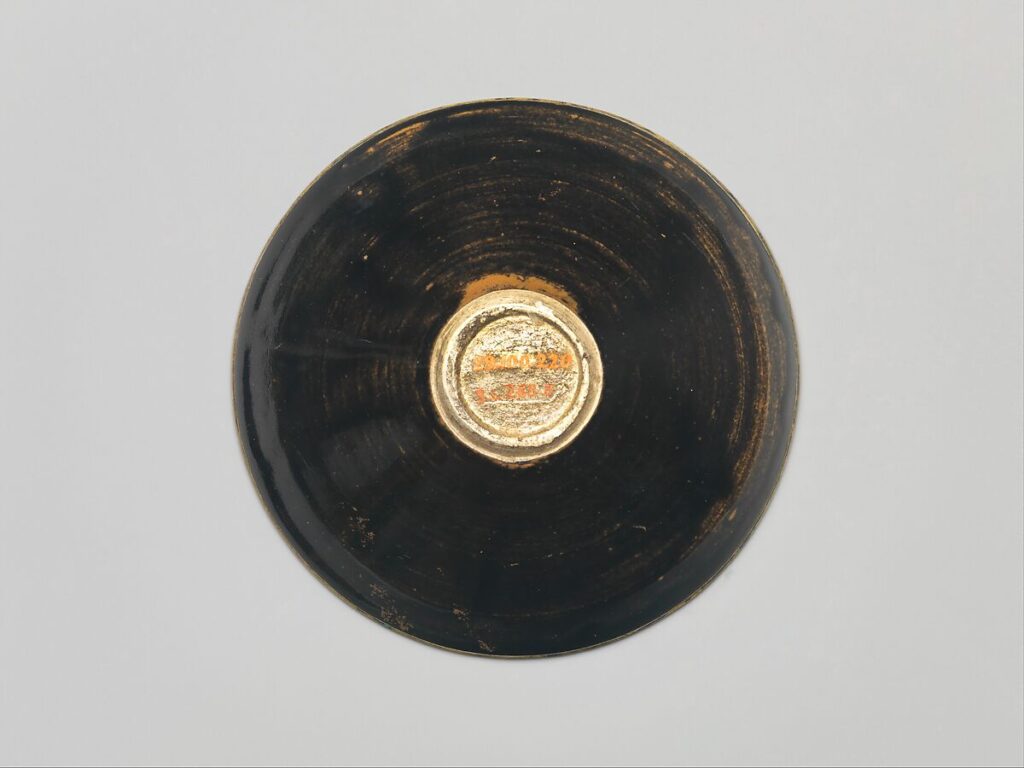
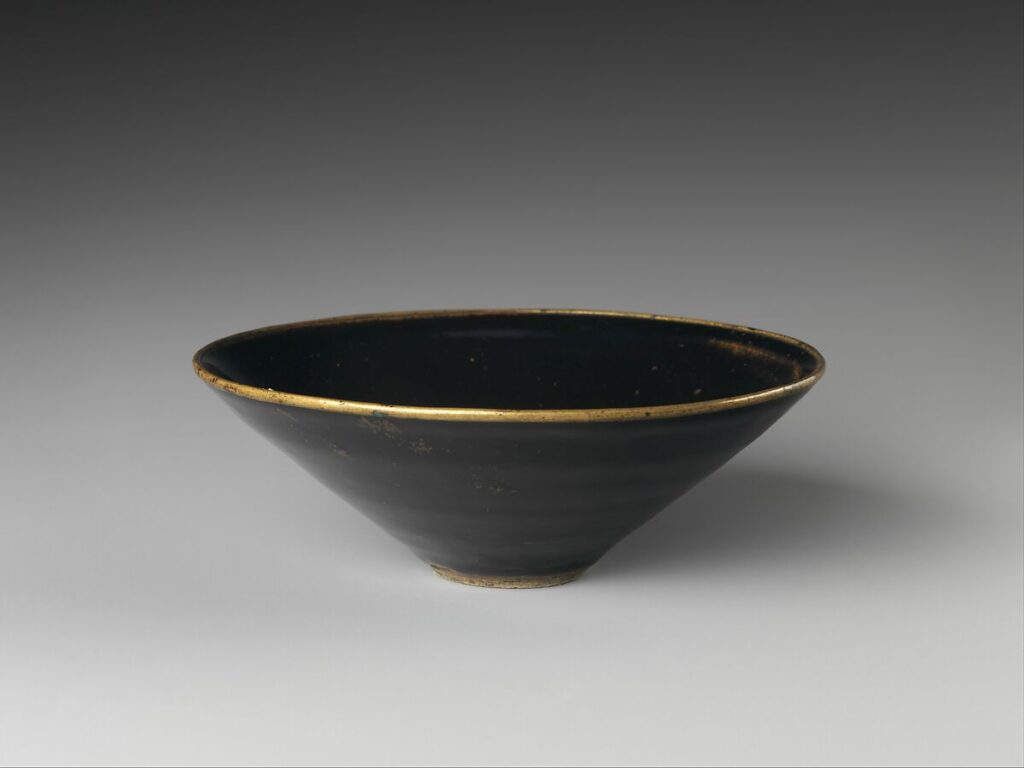
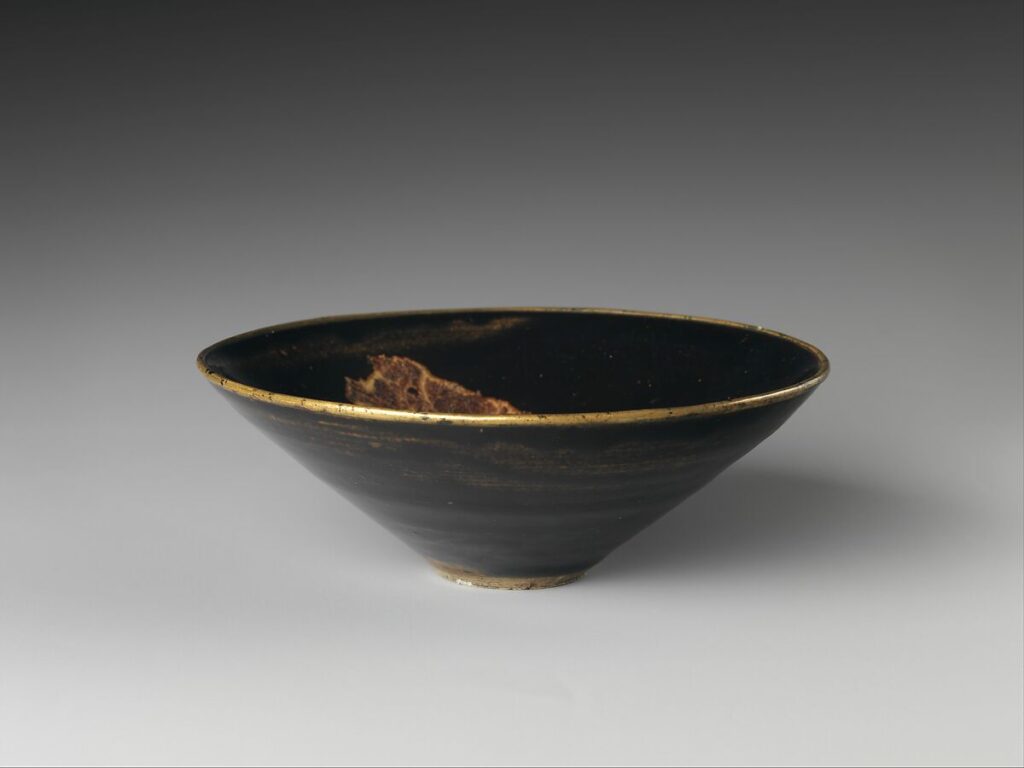
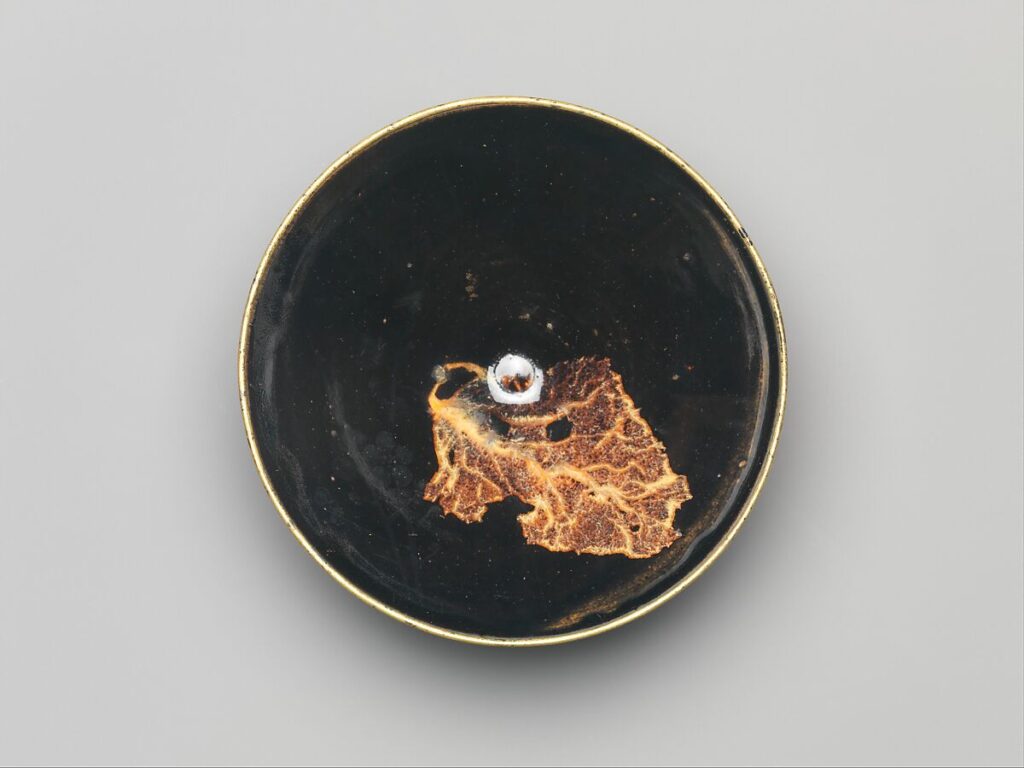
The Metropolitan Museum of Art, New York. H. O. Havemeyer Collection, Bequest of Mrs. H. O. Havemeyer, 1929. Object 29.100.220. Public Domain / The Met Open Access. View museum record →
The Jizhou history does not make modern Leaf Jianzhan an imitation. It tells us where the broader Chinese wood-leaf ceramic tradition developed before modern Jian artists began adapting the concept to Jian ware.
What Kind of Leaf Is Used?
Mulberry leaves are strongly associated with traditional and modern wood-leaf production, and contemporary technical literature frequently describes their use. Modern makers may also experiment with bodhi leaves, maple-like leaves and other plant species.
Leaf species affect more than the silhouette. Vein thickness, moisture, mineral content, leaf maturity and preparation can all influence how clearly the leaf survives visually after firing.
A mulberry-shaped leaf is not automatically genuine, and a different leaf species is not automatically fake. A decal can reproduce a photograph of a perfectly real mulberry leaf.
Real Leaf, Transfer or Painted?
Most collectors buying modern Leaf Jianzhan are not trying to determine whether a bowl is 800 years old. The much more practical question is:
No single visual clue proves the answer, but several clues together can make a strong case.
| Examine | More Consistent with Natural-Leaf Work | Reason to Look Closer |
|---|---|---|
| Vein Structure | Major veins divide into smaller veins, which branch again into increasingly fine, irregular botanical networks. | Decorative lines branch mechanically, terminate strangely or repeat at regular intervals. |
| Symmetry | Slight asymmetry, distorted sections, uneven margins and natural variation. | A design that looks mathematically balanced or artificially cleaned up. |
| Fine Detail | Smaller veins continue naturally beyond the obvious central structure. | The image looks convincing from a distance but becomes simplified or graphic under magnification. |
| Color | Subtle variation can occur across different veins and areas of the leaf. | Perfectly uniform metallic or painted color with no visible relationship to the fired glaze. |
| Multiple Bowls | Similar species and compositions, but individual vein patterns remain unique. | The exact same leaf outline, breaks and vein intersections appear on multiple bowls. |
| Very Close View | Botanical detail remains convincing at macro distance. | Printing dots, transfer edges, obvious brush strokes or artificial metallic outlining become visible. |
Natural leaves from the same tree can look very similar in overall shape. They should not, however, contain the exact same network of tiny veins, missing sections, tears and intersections.
If a seller has ten “natural leaf” cups and several contain precisely the same microscopic leaf image, a reusable transfer, decal or other reproduction process becomes much more likely.
Other Ways to Put a Leaf on a Bowl
Not every non-natural-leaf decoration is automatically bad ceramic work. The problem begins when one technique is sold as another.
A photographed or illustrated leaf can be reproduced repeatedly. This can create a very clean image, but it should not be represented as a unique natural leaf fired into the bowl.
A skilled painter can create beautiful leaf decoration. It is still painted decoration rather than natural-leaf firing.
A real leaf can be pressed into soft clay to leave a physical impression. That also uses a genuine leaf, but it is a different ceramic technique.
Leaf imagery may be added after the bowl’s primary firing and fixed in a later decorative firing. Again, this is not automatically poor workmanship, but it should be described accurately.
A $30 decal bowl honestly sold as a decorative tea bowl is not the same problem as a $300 bowl advertised as a difficult natural-leaf firing when it is actually a transfer. Accurate description matters.
Authentication Myths
Too absolute. The amount of relief can vary with technique, glaze thickness, leaf preparation and firing. Some successful natural-leaf work may be extremely smooth, while other genuine processes can leave slight texture or unevenness.
Not necessarily. Natural leaves contain extremely fine structures, and successful leaf firing can preserve remarkably crisp detail. Look at how the vein network behaves, not simply how sharp it is.
A decal can reproduce a photograph of a real mulberry leaf perfectly. Species identification alone does not establish how the image was made.
Completely separate question. Another maker can produce a real natural-leaf bowl and still place a false attribution, copied stamp or mismatched certificate with it.
What Makes a Good Leaf Jianzhan?
Once you are satisfied that the technique is accurately described, the next question is simply whether you like the execution.
Quality is partly personal, but collectors commonly consider:
- Leaf clarity: Are enough of the main and secondary veins visible to make the leaf feel alive?
- Composition: Does the placement of the leaf work with the shape of the bowl?
- Glaze relationship: Does the surrounding glaze complement rather than overwhelm the leaf?
- Leaf survival: Are missing areas attractive and natural-looking, or did too much of the intended design fail?
- Surface: Are any rough sections minor and acceptable, or would they interfere with use and cleaning?
- Bowl quality: Look beyond the leaf at the form, foot, glaze application and overall firing.
- Personal appeal: A technically perfect leaf is not automatically the most beautiful one.
Buying Leaf Jianzhan Online
Livestreams and seller photographs often show the bowl from its most flattering angle. Before buying an expensive piece, ask to see enough of the bowl to evaluate both the leaf and the Jian Zhan itself.
- Full leaf in neutral light
- Macro view of fine veins
- Edge of the leaf at an angle
- Short video tilted under light
- Full interior
- Full exterior
- Foot and exposed clay
- Maker’s stamp close-up
- Certificate front and back
- Box and labels
- QR verification where applicable
- Artist or workshop provenance
If the seller has several Leaf Jianzhan from the same batch or artist, ask to see two or three together. Similar leaves are normal. An identical leaf image repeated perfectly is much more informative.
Questions to Ask the Seller
You do not need to know the artist’s secret recipe. A reputable seller should still be able to tell you what kind of decoration you are purchasing.
| English | Chinese |
|---|---|
| Is an actual natural leaf used to make this pattern? | 这个木叶纹是用真树叶烧制的吗? |
| Is the leaf printed, transferred, painted or hand-drawn? | 这个叶子是贴花、转印、彩绘或者手绘的吗? |
| Can I see a close-up photo of the leaf veins? | 可以看一下叶脉的近照吗? |
| Can I see the bottom and maker’s mark? | 可以看一下盏底和落款吗? |
| Does this piece have a certificate or artist verification? | 这只盏有证书或者作者认证吗? |
Authenticating the Artist
Once a Leaf Jianzhan is attributed to a particular artist, especially an expensive or well-known maker, the leaf itself becomes only one part of authentication.
Compare shape, trimming and exposed body with documented pieces.
Compare character design, spacing, dimensions and placement.
Check artist name, seals, numbering, handwriting and QR system where used.
Boxes and booklets can support provenance but should not override contradictions.
Compare glaze, form and workmanship with reliable examples by the artist.
Consider who sold the piece and whether its chain of ownership makes sense.
A genuine natural leaf does not make a copied master’s stamp genuine. Likewise, a certificate cannot turn an inconsistent bowl into authentic work by a particular artist.
Quick Collector Checklist
Before buying a modern Leaf Jianzhan, ask:
- Is the seller specifically claiming a natural leaf was used?
- Do the veins branch like a real botanical structure?
- Does macro photography still look convincing?
- Are multiple bowls using genuinely different leaves?
- Is the leaf integrated attractively with the glaze?
- Is the rest of the Jian Zhan well formed and fired?
- If an artist is named, does the foot and stamp match documented work?
- Does the certificate, packaging and QR information agree with the bowl?
- Most importantly, is the seller describing the technique honestly?
Collector Summary
- Leaf Jianzhan is a legitimate and evolving part of modern Jian ware.
- Natural leaves can be combined with Rabbit’s Fur, black glaze and other Jian Zhan surfaces.
- Different artists may use different leaf preparation and glaze techniques.
- The older wood-leaf ceramic tradition is most famously associated with Jizhou Kiln.
- A real natural leaf does not automatically mean high quality.
- A real natural leaf does not authenticate a famous artist.
- Exact repeated leaf vein networks across multiple bowls are a significant warning sign.
- Surface height, crispness or leaf species should never be used as a single pass/fail test.
- Painted, printed and transferred leaf decoration can still be attractive, but it should be sold for what it is.
Sources & Further Reading
The Metropolitan Museum of Art
Tea Bowl with Leaf Decoration, Southern Song dynasty, 12th–13th century.
Jizhou ware, Object 29.100.220.
View museum record →
China Arts & Crafts Society · 中国工艺美术学会
Biographical account of Sun Jianxing and the modern revival of Jian ware,
including his development of Rabbit’s Fur wood-leaf bowls and larger double-leaf works.
View source →
Published Interview with Cai Binglong · 蔡炳龙
Interview discussing his modern Jian Zhan wood-leaf technique.
Cai states that his bowls use real leaves and describes his method as an embedded-glaze process
distinct from Jizhou wood-leaf production.
View interview →
Chinese Patent CN109721249A/B
Modern technical discussion of leaf-based ceramic glaze preparation.
The patent describes natural leaves, variation in leaf vein structure,
processing challenges and difficulties obtaining consistent fired results.
View patent →
Chinese Patent CN112374756B
A modern ceramic process combining Jizhou-style wood-leaf decoration with Longquan glaze techniques.
The documented method uses mature mulberry leaves that are boiled, dried and flattened before firing.
View patent →
People’s Daily Culture · 人民网文化
Discussion of historic Jizhou wood-leaf bowls, reconstruction theories and the limitations
of simple surface-based authenticity tests.
View source →
Fifty Shades of Clay
Sun Jianxing · 孙建兴 →
Fifty Shades of Clay is an independent educational resource for Jian Zhan collectors. Collector guidance is intended to identify useful evidence and warning signs rather than provide absolute authentication from photographs alone.